
2C-3A Haircut: Best Cuts, Layers and What to Ask For

The best haircut for 2C-3A hair is a layered cut shaped around your dry, natural curl pattern. It is usually long soft layers or a light shag if your hair leans wavy, and medium layers if it leans toward defined curls. The stylist should cut with shrinkage in mind and should never cut a stretched, wet version of your hair. The rest of this guide shows how to choose a length, how layers change your shape, and what to say in the chair.
TL;DR
- Wavier 2C hair usually suits long, soft layers or a light shag. Defined 3A curls usually suit medium layers that balance volume and silhouette.
- Ask for a dry cut in your natural state, because wet cutting can underestimate shrinkage and leave you with an uneven, shorter result.
- Layers remove bulk and stop a triangle shape, but too much texturizing can break up the curl pattern and cause frizz.
- Fine or thin hair does better with a rounded shape and restrained layering, not heavy thinning.
- Bring photos, but let your stylist adapt the idea to your density, spring and shrinkage.
Table of Contents
- What 2C-3A hair actually means for a haircut
- Shapes and lengths that work for 2C-3A hair
- How layers change volume, shape and definition
- If your 2C-3A hair is fine or thin
- Dry cutting versus wet cutting
- Thinking about going short
- How reference photos help (and where they mislead)
- Getting ready for your appointment
- What to say in the chair
- Our perspective
- Book a cut designed around your curls
- FAQ
- Sources
What 2C-3A hair actually means for a haircut
The 2C-3A range sits where waves turn into curls. Many people in this range say their hair changes by the day: more S-shaped and wavy in humid weather, more spiral and defined after a good wash day. Some have a mix of both patterns on one head, with tighter curls underneath and looser waves on top.
That in-between quality is why a generic “curly cut” can go wrong. A cut that suits loose waves can leave tighter curls puffy and wide. A cut built for tight spirals can leave waves flat and heavy at the ends. One company interview with a curl specialist makes the same point: choose the cut only after assessing curl type, porosity and density, since those factors decide the shape, the layer length and how weight is removed.
So three questions matter more than the label on your hair type:
- How does the curl pattern behave when dry and unstyled? Is it mostly waves, mostly curls, or a mix?
- How dense is it? Thick hair holds weight and needs more bulk removal. Fine hair needs shape without losing volume.
- How much does it shrink? This decides how long to leave it.
Shapes and lengths that work for 2C-3A hair
Vogue’s guide to curly layered cuts gives a clear starting point: for type 2 hair, ask for long, soft layers or a light shag, and for type 3 curls, medium layers that balance volume and define the silhouette. The same piece says a customized layered cut tends to suit almost any face shape, so you do not need to match the cut to your face as strictly as you might with a straight cut.

Long soft layers
This is the safest choice for the wavier end of the range. You keep length, the layers help waves move instead of hanging flat, and the shape stays easy to grow out. If you want to keep your length but dislike how your hair sits, this is where to begin.
The curly shag
A shag adds shape at the crown and around the face while keeping weight through the back. Vogue’s August 2026 curly-shag guide describes the look as shorter crown and face-framing layers with length and weight kept through the back, which creates shape and movement. The same article says looser waves tolerate more layering for movement, while tighter curls need closer attention to shrinkage. For a 2C-3A head, that means the shag should be tuned to the tighter sections of your hair, not to the loosest ones.

Medium layers and the layered bob
If your hair is closer to 3A, medium-length layers around the shoulders keep curls defined without letting the bottom spread out. Vogue’s expert guide to layered cuts says natural curly hair generally benefits from layers that create a rounder shape, and that triangular silhouettes and excess width at the bottom are best avoided. A rounded layered bob follows the same logic at a shorter length.
What to be careful with: the one-length cut
A straight, precise, one-length cut can look boxy or heavy at the bottom on curly hair, according to a report quoting professional hairstylists. That is the main reason 2C-3A hair often ends up in the dreaded triangle: the top is light, and the bottom stacks up with nowhere to go.
For more ideas to browse, our guide to styles that suit curly hair and our overview of haircuts that enhance your curls show how these shapes look in practice.
How layers change volume, shape and definition
Layers are the main tool in a 2C-3A cut, and they work in two directions at once. Used well, they remove excess weight so curls can spring up and move. Used too heavily, they break the curl pattern apart.
Byrdie’s curly-cutting guide puts it plainly: layers can remove bulk and help curls move, preventing a triangular shape, but weight should stay at the ends, because over-texturizing can disrupt the pattern and cause frizz.
Here is how that plays out in practice:
| Goal | What layers can do | What to watch |
|---|---|---|
| Less triangle, more roundness | Remove bulk through the mid-lengths so the shape stays round | Do not strip the ends, or curls lose their weight and clump less |
| More movement in waves | Longer, softer layers let waves lift and swing | Too few layers leave waves flat and heavy |
| More definition in curls | Shorter layers around the crown and face let curls stack neatly | Choppy layers can frizz and separate |
| Keeping length | Layers placed through the crown and face, with the back left long | Ask clearly for the length you want to keep |
For a deeper look at what layering does for volume, see our piece on the benefits of layered hair and our list of volume-boosting haircuts.
If your 2C-3A hair is fine or thin
Fine 2C-3A curls are one of the most common concerns behind this search, and the answer is different from the thick-hair advice above. Vogue’s guide to haircuts for thin hair recommends a rounded layered cut such as a curly shag or layered bob, plus a dry cut so the stylist sees the natural fall, and a lightweight curl cream or mousse for styling.
Two cautions come up in the research from the fashion press:
- Vogue’s fine-hair guide says excessive layering can remove volume, while a blunt or one-length cut at short-to-shoulder length can look fuller. On curly hair, that blunt idea needs care, which is why a rounded shape with limited layers is the middle path.
- Byrdie’s guide to medium layers says thin hair can benefit from face-framing layers, but too many or choppy layers may remove the volume you want to keep.
The practical takeaway: ask for fewer, well-placed layers, concentrated at the crown and around the face, and keep density at the ends. If you want to understand how a stylist reads fine hair, our curly hair care guide covers the routine side.
Dry cutting versus wet cutting
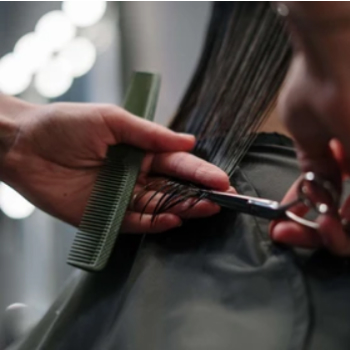
Most of the advice on cutting curls comes back to this one decision. Cutting hair wet stretches the curl, and curls spring back shorter and sometimes unevenly. Cutting dry lets the stylist see where each curl actually sits.
The report from professional hairstylists says dry cutting lets the stylist see the natural curl, shape and length, account for shrinkage and cut curl by curl to remove bulk. It also says wet cutting may work for tight-to-loose waves and very loose 3A curls. For a 2C-3A head, that means a wet cut is not always wrong on the wavy side, but dry is the safer request when you have tighter curls in the mix. The same report quotes stylists warning that wet cutting can underestimate shrinkage and produce an unexpectedly short or uneven result.
A few technical details are worth knowing, because they explain what a careful curl cut looks like:
- Low tension. A DevaCurl Academy educator in a Modern Salon interview says curly hair should be cut with loose-to-no tension, and that elevation should vary by curl type, with tighter curls generally needing lower elevation.
- Dry finishing. A Connected Hair interview describes finishing dry to adjust length after the curl has formed, plus point-cutting and angled scissor work to create softer transitions, instead of relying only on the stretched wet length.
- Curl-following geometry. The idea is to diagnose how your curls behave, then cut with the curl pattern, not one flat formula for every texture.
If you want to know what the method looks like step by step, read our explanation of what dry cutting is and our guide to cutting curly hair techniques.
Thinking about going short
Short cuts on 2C-3A hair can look great, but they carry the highest risk of surprise. Byrdie’s guide notes that curly hair can shrink more than expected, and some clients gain as much as five inches when their hair is wet. It advises deciding how much length to remove and remembering that less is more.
The Yahoo report puts the range wider: shrinkage may run from 20% to 70% depending on curl texture. In practical terms, if your hair hangs at your shoulders when stretched, it might sit far higher once it dries and springs up. That is why the sensible way to go short is in stages: take a first cut that is a little longer than your goal, see how your hair settles, then refine.
The first-time short cut checklist:
- Ask the stylist to cut dry or to finish dry, so they can check the length as the curl forms.
- Name your target in terms of where it should land after it dries and curls, not where it hangs when stretched.
- Ask what your hair will do in the first week, such as sitting wider at the sides, and how to style it.
- Plan a follow-up trim, because the shape often needs a small adjustment once it settles.
Our article on choosing short styles for women goes deeper on the decision.
How reference photos help (and where they mislead)
Photos are the fastest way to show a stylist what you want. They communicate silhouette, layering, face framing and how much length to keep. Vogue’s stylists add an important limit: the same haircut idea can work across textures only when its execution changes for the individual.
So when you choose photos:
- Look for hair that is close to yours in density and curl pattern, not only in color or length.
- Bring two or three images, and say what you like in each: the crown shape, the face framing, the length at the back.
- Include a photo of your hair as it looks on a good day and a normal day. It tells the stylist how much your pattern varies.
- Be ready to hear that part of the picture will not work on your hair. That is a good sign, not a bad one.
Getting ready for your appointment
Modern Salon’s preparation advice is simple: arrive with clean, detangled hair worn as you normally style it, without ponytails or headbands and with minimal product, so the stylist can see the natural curl pattern.
A good consultation then covers the points below. You can almost read from this list when you book:
- Your curl pattern on the day, and how it changes with weather.
- Your routine: how much time you spend, and whether you air-dry or diffuse.
- Your goal: more volume, less bulk, more definition, or a change of length.
- Any recent color or chemical work, since it changes how curls behave and how they should be cut.
What to say in the chair
Here is a script you can adapt, based on the research above:
“I have 2C-3A hair, wavy in some places and curly in others. I would like a dry cut, with my hair in its natural state. I want to keep most of my length and remove bulk without losing my curl pattern. Please add soft layers around the crown and face, and keep weight at the ends so I avoid a triangle shape.”
For a curly shag, Vogue’s stylist advice says to specify shorter crown layers, substantial face framing, movement and retained overall length, and that the layers need not be perfectly blended. For a shorter cut, add the line “let’s go a bit longer first and refine after it dries.”
For men with 2C-3A hair, the same logic applies at a shorter scale: dry assessment, controlled weight at the sides and shape on top. Our guide on styling curly hair for men shows how to keep the result defined.
Our perspective
Wavy-curly hair is where a salon’s training shows most. The label 2C or 3A tells us a range, but it does not tell us how your hair falls, how dense it is, or how it behaves when you leave the house in the morning.
That is why a personalized consultation is the first step of every cut at our studio, before any scissors come out. We look at your pattern, your density and the way you live with your hair, then we design the shape around that. Our founder has more than 25 years of experience, and our handpicked team of stylists approaches every head as individual work, not a template.
We care about creative expression and technical precision in equal parts. A good curl cut should feel like yours, and it should still look intentional on the days when the weather or the schedule does not cooperate. Hair health and careful salon practice stay part of the work from start to finish.
Juiced
Book a cut designed around your curls
If you live in or near La Jolla and want a haircut built around your pattern, we start with a consultation and tailor the cut to you. Our published prices are $60-$75 for a women’s haircut and $45-$50 for a men’s haircut. A blow dry style is $45-$75, and deep conditioning with a blow dry style is $80-$85.

If you also want to change your color, our services include balayage, highlights and all-over color, all listed with prices on our services page. For a wedding or event, our special occasion updo starts at $100. If you are adding color to curls, our color consultation checklist explains what to cover first.
FAQ
Should I get my 2C-3A hair cut wet or dry?
Dry is the safer request, especially if your hair has tighter curls. Professional stylists quoted in the research say dry cutting lets them see the natural shape and account for shrinkage. Wet cutting can work for waves and very loose 3A curls, but it can underestimate how much your hair springs up.
What layers are best for 2C-3A hair?
Long, soft layers or a light shag suit the wavy side, while medium layers suit the more defined curls. The aim is a rounded shape with weight kept at the ends. Heavy layering or over-texturizing can disrupt the curl pattern and lead to frizz.
Can fine, thin 2C-3A hair have layers?
Yes, but keep them limited. Vogue suggests a rounded layered cut such as a curly shag or layered bob for thin curly hair, ideally cut dry. Too many or choppy layers can remove the volume you are trying to keep, so ask for face framing and crown shape without heavy thinning.
How short can I go with 2C-3A curls?
Shorter than you think is a common mistake. Curly hair can shrink by anywhere from 20% to 70% depending on texture, and some clients gain several inches in length when wet. Take a little less off than your goal, let it settle, and refine at a follow-up trim.
What should I do with my hair before the appointment?
Come with clean, detangled hair styled as you normally wear it, with minimal product and no ponytail or headband. That lets the stylist see your natural pattern and plan the cut around it.
Sources
- A Curly, Layered Haircut for Every Face Shape, Vogue
- Exactly How To Get The Sterling Point Curly Shag, Vogue
- The 10 Best Layered Hairstyles, According to the Pros, Vogue
- The Best Haircuts to Try if You Have Thin Hair, Vogue
- The 4 golden rules of curly haircuts, Yahoo
- How to Cut Curly Hair: A Step-By-Step Guide, Byrdie
- 55 Chic Medium-Length Layered Haircuts for All Textures, Byrdie
- Answers To The Most Frequently Asked Questions About Cutting Curly Hair, Modern Salon
- Cutting curls and the secrets of textured cuts, Connected Hair