

Salon Prices for Services: What You Should Expect

TL;DR:
- Salon prices reflect real costs, skills, and market conditions rather than arbitrary figures, which explains wide variations.
- Understanding these factors helps clients evaluate and compare salon services accurately across different locations and stylists.
You searched for salon prices for services because the numbers you saw didn’t make sense. One salon charges $45 for a haircut. The shop two blocks away charges $120. Neither one explains why. That gap isn’t random. Salon pricing reflects real costs, real skill levels, and real market conditions that most clients never see. This guide breaks down what average salon costs actually look like across the U.S., explains why prices vary so dramatically, and gives you a practical framework for comparing beauty service prices without getting burned.
Table of Contents
- Key takeaways
- Salon prices for services: national benchmarks
- Why salon prices vary so much
- How salons calculate their prices
- How to compare salon prices near you
- My take on pricing and value at modern salons
- Experience the difference at Joel C Ma Hair Studio
- FAQ
Key takeaways
| Point | Details |
|---|---|
| National haircut averages cluster low | Most clients pay $20 to $35, with a transaction-weighted average of $29 to $30 nationally. |
| Location shifts prices significantly | Salon service rates run 20 to 50% above national averages in major metros and 10 to 30% below in smaller cities. |
| Overhead drives the floor price | Payroll, rent, and supplies push even minimum prices above what many clients expect. |
| Balayage ranges wildly | Expect $100 to $300-plus depending on hair length, technique, and your local market. |
| Comparison requires context | Stylist level, hair length, and service inclusions all affect whether two price quotes are even comparable. |
Salon prices for services: national benchmarks
Before you can compare prices in your area, you need a realistic baseline. The numbers floating around online are often misleading because they mix data from student clinics, independent stylists, and luxury salons in the same bucket.
Here is what the data actually shows for common services across the U.S.:
| Service | Typical Range | National Average (Transaction-Weighted) |
|---|---|---|
| Women’s haircut | $25–$95 | ~$45–$55 |
| Men’s haircut | $15–$50 | ~$29–$30 |
| Full color (single process) | $60–$150 | ~$80–$100 |
| Balayage | $100–$300+ | ~$150–$200 |
| Blowout/blowdry | $35–$85 | ~$45–$60 |
| Beard trim | $15–$35 | ~$20–$25 |
| Highlights (partial) | $70–$160 | ~$90–$120 |
The key word in that table is transaction-weighted. A transaction-weighted average better reflects what clients commonly pay than a straight mean would, because it accounts for volume. Most haircut transactions happen in the $20 to $35 range, which pulls the practical average down even though luxury appointments can push $200 or more.
Balayage pricing is one of the best examples of how wide a service range can get. The national balayage range runs from $100 to over $300 depending on hair length, technique complexity, and local demand. That is not price gouging. That is a reflection of how different the service actually is from one client to the next.
Pro Tip: When you see a salon listing a haircut at an unusually low price, ask what is included. Many budget haircuts exclude a wash and blowdry, which can add $20 to $40 to your final bill.
Student clinics occupy a separate category worth knowing about. Places like training academies offer starting prices as low as $20 for a hairstyle, but those base rates come with important conditions. Prices often apply to specific date windows, and base rates vary by hair length and density. The tradeoff is skill and speed, not just price.
Why salon prices vary so much
The most common misconception people bring to salon price comparisons is that salons set prices based on what they want to make. In reality, salon monthly expenses range from $8,000 to $40,000-plus, with payroll typically eating up 40 to 60% of revenue. Rent adds another 8 to 15%. Products and utilities bring the total overhead to a number that sets a hard floor on what a profitable salon can charge.

That floor shifts depending on where you live.
Location and cost of living
Salon prices run 20 to 50% above national averages in major metropolitan areas and 10 to 30% below in smaller cities. A haircut in Manhattan or San Francisco that costs $90 would be $50 in a mid-sized Midwestern city for the exact same technical work. Neither is wrong. Both reflect the actual cost of running that business in that location.
Stylist experience and specialization
A junior stylist fresh out of cosmetology school and a master colorist with 20 years of experience both do haircuts. But they are not offering the same service. Experienced stylists charge more because their time is limited, their error rate is lower, and their ability to handle complex work is higher. At Joel C Ma Hair Studio, the pricing reflects over 25 years of expertise. That number is not decoration on a website. It represents faster problem-solving and better outcomes for clients with complicated hair histories.
Business model differences
A booth renter working independently inside a salon has different overhead than a full-service salon with multiple employees, a receptionist, and a premium retail space. Independent stylists sometimes charge less because their overhead is lower. But they also may lack the product inventory, the support staff, and the walk-in capacity that a full salon provides.
“Pricing transparency improves client satisfaction and trust, making it critical for salons to clearly communicate service inclusions and fees.” — Joel C Ma Hair Studio
When a salon does not list prices online or refuses to give a range before your appointment, that is not a good sign. Transparent pricing is a signal of a well-run business.
How salons calculate their prices
Most clients assume salons pick a number that sounds reasonable. What actually happens involves a formula based on real costs. Here is how the math works at a basic level:
- Calculate monthly operating costs. Add up rent, payroll, product costs, utilities, insurance, and marketing. For an average salon, this lands somewhere between $8,000 and $40,000 per month.
- Determine billable hours. How many client appointments can a stylist realistically complete per week? Factor in prep time, cleanup, and no-shows.
- Set a target hourly rate. Divide total monthly costs by total billable hours to find the break-even rate per hour.
- Add profit margin and taxes. A 20 to 25% profit margin is standard. Self-employment tax adds roughly 15% on net income for independent stylists, raising final prices beyond what pure cost recovery would require.
The result is a floor price, not a ceiling. That is the minimum the salon can charge without losing money. Using this method, a women’s haircut floor price lands around $80 to $85, while a balayage with cut has a floor closer to $225 to $230. These numbers explain why a quality full-service salon cannot responsibly charge $30 for a women’s cut.
| Service | Calculated Floor Price | Typical Charge |
|---|---|---|
| Women’s haircut | ~$80.64 | ~$85 |
| Balayage + cut | ~$225.78 | ~$230 |
Add-on treatments follow a similar logic. High-margin treatments are often priced at three to four times product cost plus time. They look expensive on a menu but represent legitimate profit opportunities that keep the salon viable.
Pro Tip: When reading a salon menu, look for a service that includes wash, cut, and style as a package. This gives you a true all-in price, making it far easier to compare one salon to another without doing mental math at the register.
Salon menu price anchoring is also a real factor. Anchor services on a menu are often priced at roughly 2.5 times the core service price. Their purpose is to make standard services look affordable by comparison. Recognizing this psychology helps you evaluate what you are actually getting for the price.
How to compare salon prices near you
Comparing salon service rates effectively requires more than scanning a price list. Two salons can both advertise a “$60 haircut” and be offering completely different things.
Here are the factors to check before making a real comparison:
- What is included. Does the price include a wash, cut, and blowdry? Or just the cut? A blowout alone can run $35 to $85 as a standalone service.
- Stylist level. Many salons have tiered pricing based on stylist seniority. The posted price may be for a junior stylist. Always ask whether a senior or master stylist costs more.
- Hair length and density adjustments. Most salons adjust color and treatment prices for long or thick hair. A $150 balayage quote for a client with short hair may double for someone with waist-length hair.
- Add-on fees. Toners, glosses, deep conditioning treatments, and styling products are frequently billed separately. Ask upfront what the quoted price covers.
When using national averages as benchmarks, always adjust for your city size. A quote 30% above national average is completely normal in a high-cost metro and does not mean the salon is overcharging.
Pro Tip: Call the salon and describe your hair in detail before booking. A good salon will give you a realistic range instead of a single number. If they refuse, that unwillingness to communicate price upfront is worth factoring into your decision.
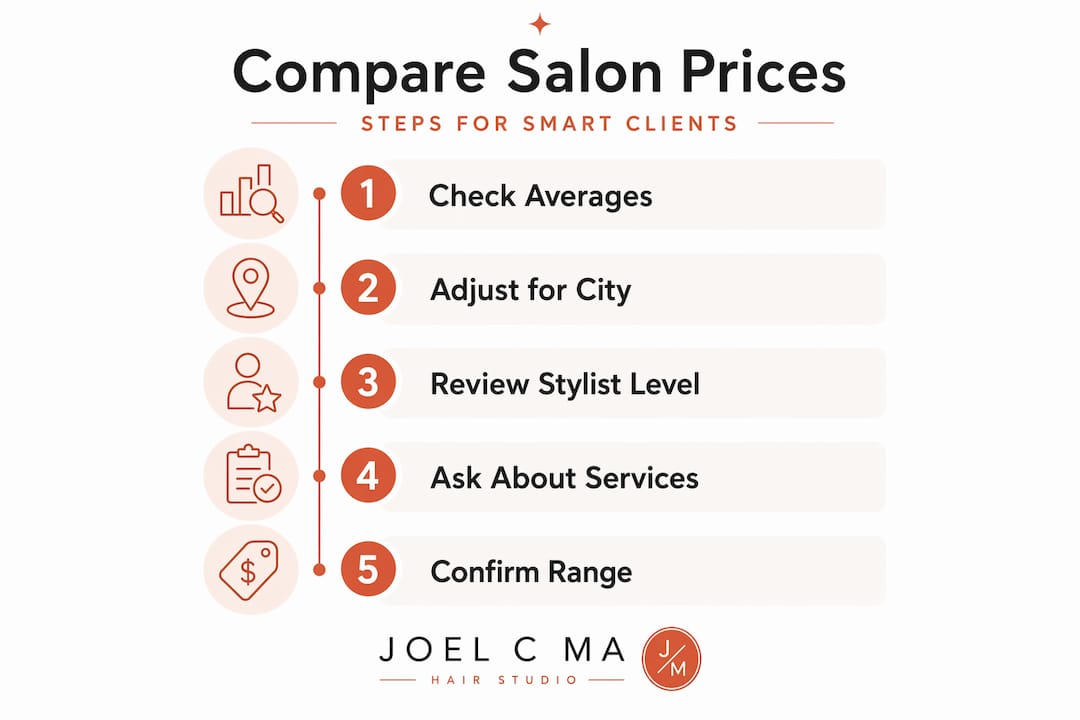
Comparing salons accurately requires factoring in stylist level, hair length, and service complexity. Ignoring these variables leads to misleading assumptions about affordability. The client who books the cheapest option without asking these questions often ends up paying more in corrections later.
My take on pricing and value at modern salons
I’ve spent enough time in and around premium salons to say this clearly: most client frustration around pricing comes from incomplete information, not actually unfair prices.
I’ve seen clients walk into a luxury salon expecting street-corner prices because they found a coupon online and skipped the consultation call. And I’ve seen other clients leave a $50 appointment underwhelmed, realizing too late that the low price meant a rushed service with no color consultation and a blowdry that was optional at extra cost.
What I’ve learned is that the best value is almost never the cheapest number. It is the clearest number. A salon that tells you exactly what you are getting, at what skill level, with what add-ons baked in, is worth more than one that posts a low number and bills you out the door. Luxury salons that succeed with high-end clients combine trend awareness with honest pricing that actually justifies the cost.
My honest advice: call ahead. Ask about stylist levels. Ask what the price includes. Ask if your hair length will change the quote. A salon worth your money will answer all three questions without hesitation.
— Joelcma
Experience the difference at Joel C Ma Hair Studio
If this guide helped you understand what you are actually paying for at a salon, the next step is finding a team that delivers on those standards.

At Joelcma, the service menu is built around transparency and real expertise. Whether you are researching professional haircut options or exploring color services like balayage, the pricing reflects over 25 years of skill and a genuine commitment to personalized results. The team at Joel C Ma Hair Studio in La Jolla, California works with clients to set expectations before the appointment starts, not after. For clients serious about their hair and tired of guessing what a service actually costs, Joelcma is where that guesswork ends. You can also explore color-safe shampoo options to protect your investment between appointments.
FAQ
What is the average cost of a haircut in the U.S.?
The national average haircut price is approximately $29 to $30 for men, with most transactions clustering between $20 and $35. Women’s cuts average $45 to $55 when wash and blowdry are included.
Why do salons in big cities charge so much more?
Salon prices in major metros run 20 to 50% above national averages because rent, payroll, and overall operating costs are significantly higher than in smaller cities.
How much should I expect to pay for balayage?
Balayage typically costs between $100 and $300-plus nationally, with the most common price range clustering around $150 to $200. Hair length, density, and technique complexity all affect the final price.
Are student salon prices worth it?
Student salons offer real savings, with services starting around $20, but prices are often conditional on specific dates and base rates can increase for longer or thicker hair. The tradeoff is longer appointment times and less predictable results.
What does a salon’s floor price mean for me?
A floor price is the minimum a salon can charge without losing money on a service. For a women’s haircut at a quality salon, that floor typically lands near $85. Understanding this helps you recognize when a price quote is genuinely competitive versus when it likely reflects a compromised service.