
Different Texture Hair: Your 2026 Guide to Every Type

TL;DR:
- Hair texture is determined by curl pattern and strand thickness, requiring tailored care for effectiveness. Understanding your full profile, including porosity and density, is essential for selecting proper products, cuts, and routines. Texture can change over time due to hormones, damage, and environment, making consistent assessment crucial for optimal hair health.
Different texture hair is defined by the combination of curl pattern and strand thickness present on an individual’s head, and getting both factors right is what separates effective hair care from guesswork. Most people know their curl type from a chart, but far fewer understand that two people with identical curl patterns can need completely different products if one has fine strands and the other has coarse ones. The industry standard term for this full picture is hair texture profile, and it covers curl pattern (Types 1 through 4), strand thickness (fine, medium, or coarse), porosity, and density. Hybrid textures, where multiple curl patterns coexist on one scalp, are more common than any chart suggests. Understanding your complete texture profile is the single most reliable path to choosing the right cuts, products, and routines.
What are the different hair textures and how do they work?
Hair is categorized by curl pattern into Types 1 through 4, with A, B, and C subtypes indicating increasing tightness or coarseness within each category. Type 1 is straight, Type 2 is wavy, Type 3 is curly, and Type 4 is coily or kinky. The subtype letters move from looser to tighter: 2A is a gentle beach wave, while 4C has minimal curl definition and the tightest coil pattern of all.
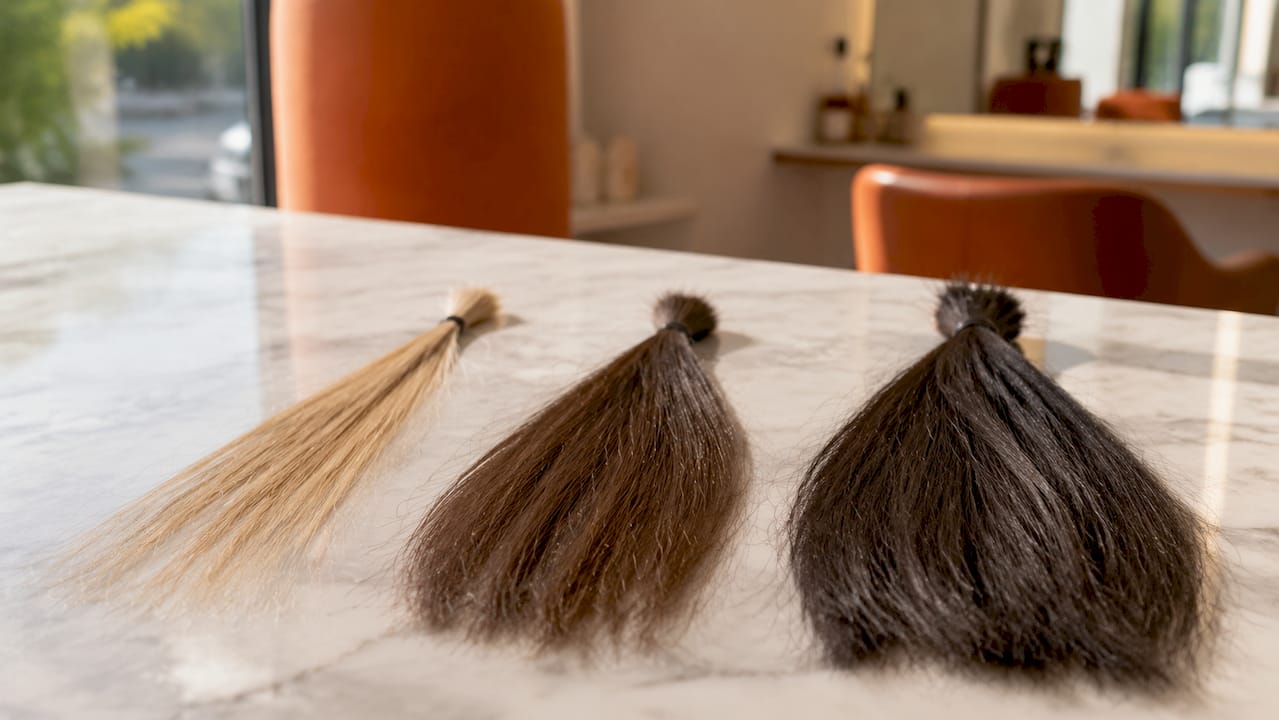
Here is where most people get tripped up. Hair texture and hair type are distinct concepts: type refers to curl pattern, while texture refers to strand thickness. A 3B curl can sit on a fine strand or a coarse one, and those two scenarios call for entirely different conditioners, styling products, and even haircut techniques. Treating them as the same thing is the root cause of most product failures.
Beyond curl pattern and strand thickness, two more factors complete the picture. Porosity describes how readily your hair absorbs and retains moisture, and density refers to how many strands grow per square inch of scalp. Separating curl pattern, strand thickness, and porosity is the foundation for selecting products that actually perform. Skipping any one of these variables leaves a gap in your routine.
How do you identify your specific hair texture pattern?
Accurate identification starts with a clean slate. True natural hair texture reveals itself best when hair is clean, product-free, and air-dried without heat or manipulation. Blow-drying, flat-ironing, or even scrunching with a towel distorts the natural pattern enough to send you to the wrong category on any chart.
Once your hair is air-dried, run through this identification process:
- Curl pattern check: Hold a single strand up to natural light and compare it against the Andre Walker 1A to 4C chart. Look at multiple strands from different zones of your scalp, not just the top layer.
- Strand thickness test: Roll a single strand between your fingers. Fine hair feels like almost nothing is there. Medium hair feels like a thread. Coarse hair feels substantial and may even feel slightly rough.
- Zone mapping: Check your nape, temples, crown, and sides separately. Many people have 2C waves at the nape and 3A curls at the crown. This is a hybrid texture, and it is completely normal.
- Porosity observation: Watch how your hair responds to humidity over several days. Hair that frizzes immediately in humid air typically has high porosity. Hair that resists moisture and takes forever to dry tends toward low porosity. Note that at-home float tests are unreliable; behavioral observation over time is far more accurate.
Pro Tip: For reliable curl assessment, evaluate your hair under the same conditions each time: same day of the week, similar humidity levels, and always air-dried. This eliminates phantom changes caused by weather or product buildup and gives you a true read on your texture.
Most hair type charts do not account for mixed textures present on a single scalp. Treating your hair as a zonal map rather than a single category improves both care precision and styling results dramatically.

Why does hair texture change over time?
Hair texture is not fixed at birth. Hair texture can shift due to hormones, genetics, damage, lifestyle choices, and environmental exposure. Puberty, pregnancy, menopause, and thyroid changes are the most common hormonal triggers for texture shifts. Someone who had straight hair through their twenties may develop a genuine wave pattern in their thirties, not because of product use, but because of biological change.
The follicle shape determines curl pattern at the structural level. An oval or asymmetrical follicle produces a curved strand; a round follicle produces a straight one. Hormonal shifts can alter follicle shape over time, which is why texture changes are real and not imagined.
Environmental and styling factors also play a significant role:
- Repeated heat styling can loosen or destroy curl pattern over time, a condition sometimes called heat damage.
- Chemical treatments like relaxers, perms, and bleach alter the disulfide bonds in the hair shaft, permanently changing texture until new growth replaces treated strands.
- High humidity causes the hair shaft to absorb moisture from the air, swelling and creating frizz or curl in hair that appears straight in dry conditions.
- Gentler care routines often reveal hidden texture. Many people discover waves or curls they never knew they had simply by stopping heat styling and switching to sulfate-free cleansers.
Reliable curl definition assessment requires standardized conditions: same humidity level, same drying method, and no product variation. Without that consistency, you cannot tell whether a texture change is real or just environmental noise.
How does hair texture affect your care routine and products?
The right routine depends on matching your products to your texture profile, not just your curl type. Washing frequency and conditioner placement both depend on hair texture and scalp oiliness. The American Academy of Dermatology recommends washing every two to four days for most hair types, but coily hair often benefits from washing once a week or less to preserve natural oils. This matters because overwashing strips moisture that coily strands cannot replace quickly due to their tight curl structure.
Follow this framework to build a texture-appropriate routine:
- Fine hair (Types 1A to 2B with fine strands): Wash every one to two days if the scalp is oily. Apply conditioner from mid-shaft to ends only, never at the roots, to avoid weighing strands down. Use lightweight, volumizing formulas. Avoid heavy butters or oils.
- Medium hair (most Types 2C to 3B): Wash every two to three days. Conditioner can go from ears to ends. This texture handles a wider range of product weights, from light mousses to medium-hold creams.
- Coarse or coily hair (Types 3C to 4C): Wash once a week or less. Apply conditioner from roots to ends, and consider deep conditioning weekly. Curl conditioners with leave-in times of one to three minutes, like Olaplex’s N°5 Bond Maintenance Conditioner, optimize hydration and curl definition for coily strands.
- Hybrid textures: Apply lighter products to straighter or finer zones and richer conditioning treatments to coilier zones. Zonal care with varied product placement manages mixed texture hair far more effectively than a single product applied uniformly.
- High porosity hair (any texture): Use protein treatments periodically to fill gaps in the cuticle. Follow with a heavy sealant like shea butter or castor oil to lock moisture in.
Pro Tip: Your hair porosity guide is just as important as your curl type when choosing products. A 3A curl with high porosity needs completely different moisture strategies than a 3A curl with low porosity.
A healthy scalp environment directly influences how well any texture behaves and styles. Scalp health is not separate from hair texture care. It is the foundation of it.
What styling and haircut strategies work best for each texture?
The cut is the structure; the styling is the finish. Both must be engineered to your specific texture profile. A haircut must be built specifically around a person’s texture profile to balance bulk and movement. A blunt cut on thick, coarse hair creates a wall of volume with no shape. The same blunt cut on fine hair creates a clean, polished line. Same technique, opposite results.
Here is how texture changes the approach across the board:
| Texture type | Best cut strategy | Styling approach |
|---|---|---|
| Fine and straight | Blunt cuts, minimal layering | Volumizing mousse, root lifting spray |
| Medium and wavy | Long layers, texturizing techniques | Curl cream, diffuser on low heat |
| Thick and curly | Internal layers to reduce bulk | Gel or custard for definition, scrunch out the crunch |
| Coily and coarse | Shape-focused cuts, protective styles | Heavy creams, LOC method (liquid, oil, cream) |
For straight and wavy textures, chic hairstyles for fine hair focus on creating the illusion of density through strategic layering and volume-building products. For thick and coily textures, the priority shifts to managing bulk and defining the curl pattern without weighing it down.
A few styling principles that apply across all textures:
- Diffuse rather than blow-dry when possible. Direct heat disrupts curl pattern and increases frizz regardless of texture type.
- Apply products to soaking wet hair for curly and coily types. Water is the carrier that distributes product evenly through the curl.
- For fragile textures like fine hair or chemically treated strands, minimize mechanical manipulation. Pat dry with a microfiber towel instead of rubbing.
- Texturizing cuts create movement and manage bulk effectively for thick hair, but the same technique applied to fine hair removes too much weight and creates a stringy result.
Understanding the difference between layers and texture in a haircut is critical before you sit in the chair. Layers change the length distribution; texturizing changes the weight distribution within each section. Both serve different purposes depending on your texture profile.
Key takeaways
Your hair texture profile, defined by curl pattern, strand thickness, porosity, and density, determines every effective care and styling decision you make.
| Point | Details |
|---|---|
| Texture vs. type | Strand thickness and curl pattern are separate factors that both affect product and cut choices. |
| Identify on clean hair | Air-dry without products to reveal your true curl pattern and zone map your scalp. |
| Texture changes are real | Hormones, heat damage, and chemical treatments all shift texture over time. |
| Match products to texture | Fine hair needs lightweight formulas; coily hair needs rich, heavy moisture from roots to ends. |
| Cuts must suit texture | Texturizing removes bulk from thick hair; the same technique thins fine hair too aggressively. |
What 25 years behind the chair taught me about texture
Most clients who walk into Joelcma have been using the wrong products for years, not because they are careless, but because they identified only their curl type and ignored strand thickness entirely. A client with 3A curls on fine strands who uses a heavy curl butter will have flat, greasy hair by noon. A client with 2C waves on coarse strands who uses a lightweight mousse will have frizz by the time they reach the parking lot. The curl type is the same category. The texture profile is completely different.
The other thing I see constantly: people who believe their hair is straight because they have always heat-styled it. When they stop, they find waves or curls they never knew existed. Hidden texture is not a myth. It is suppressed texture, and it shows up the moment you give it the right conditions.
My honest advice is to stop chasing a single hair type label and start thinking in profiles. Your nape may be a 2B on medium strands. Your crown may be a 3A on fine strands. Those two zones need different products and possibly different techniques in the same wash session. That is not complicated once you accept it. It is actually freeing, because you stop trying to force one routine onto hair that was never one thing to begin with.
Patience matters more than any product. Texture work, whether you are embracing natural curl or managing a coarse, thick mane, rewards consistency over time. The clients who see the best results are the ones who observe, adjust, and stay curious about their hair rather than fighting it.
— Juiced
Discover expert texture care at Joelcma
At Joelcma in La Jolla, California, every service begins with a texture assessment before a single cut or color decision is made. The team’s approach is built on over 25 years of working with every texture profile imaginable, from fine, pin-straight strands to dense, tightly coiled hair that needs a completely different strategy at every step.
Whether you are navigating a texture change, trying to find the right cut for thick hair, or building a product routine from scratch, Joelcma offers customized styling consultations tailored to your exact profile. The team also curates product guidance, including a breakdown of the best salon shampoos suited to various textures and color-treated hair. Book a consultation and get a routine that actually fits your hair.
FAQ
What is hair texture and how is it different from hair type?
Hair texture refers to strand thickness, classified as fine, medium, or coarse. Hair type refers to curl pattern, classified on the Andre Walker scale from Type 1 (straight) to Type 4 (coily). Both factors together form your full texture profile.
How do I find out my real hair texture?
Wash your hair with a clarifying shampoo, skip all products, and let it air-dry completely. The pattern and behavior you see on clean, product-free hair is your real texture. Check multiple zones of your scalp, since most people have more than one curl pattern.
Can hair texture change permanently?
Yes. Hormonal shifts from pregnancy, menopause, or thyroid changes can permanently alter follicle shape and curl pattern. Heat damage and chemical treatments also change texture permanently until new growth replaces the affected strands.
What products work best for coily hair textures?
Coily hair needs rich, heavyweight moisture from roots to ends. Deep conditioners, leave-in creams, and sealants like shea butter or castor oil perform best. Brands like Olaplex offer conditioning formulas specifically timed for coily strands to maximize hydration and curl definition.
Do I need different products for different zones of my scalp?
Yes, if you have a hybrid texture. Lighter products work better on finer or straighter zones, while richer conditioners and creams belong on coilier, drier sections. Applying one product uniformly across mixed texture hair consistently underserves at least one zone.
Recommended
- Hair texture explained: your guide to tailored styling – Joel C Ma Hair Studio
- Understanding Hair Texture: The Essence of Your Style – Joel C Ma Hair Studio
- Hair Texture Chart: Know Your Hair, Transform Your Routine – Joel C Ma Hair Studio
- Types of Hair Texture: Choosing the Best Luxury Care – Joel C Ma Hair Studio