
Hair Texture Chart: Know Your Hair, Transform Your Routine
TL;DR:
- Many people confuse their hair type and texture, leading to using incompatible products and techniques. Understanding curl patterns, strand thickness, density, and porosity helps tailor hair care for healthier, more manageable hair. Regular self-assessment on clean, air-dried strands enables responsive adjustments that improve results over time.
Most people assume they know their hair type. They watch a few tutorials, pick a shampoo off the shelf, and wonder why their hair never quite does what they want. The real issue is almost always this: they’re using a hair texture chart without understanding what it’s actually measuring. Hair type and hair texture are two separate things, and confusing them leads to the wrong products, wrong techniques, and a lot of frustration. This guide breaks both down clearly, adds in the variables that most articles skip, and gives you a self-assessment process you can use today.
Key takeaways
| Point | Details |
|---|---|
| Type and texture are different | Hair type is your curl pattern (1A to 4C); hair texture is your strand thickness (fine, medium, coarse). |
| Thread comparison works | Hold a dry strand next to sewing thread to reliably identify your hair texture without guesswork. |
| Porosity changes everything | Even with the same curl pattern, high and low porosity hair need completely different products and routines. |
| Density affects product amount | How much of your scalp shows through your part tells you whether you need lightweight or volumizing formulations. |
| Assess only clean, dry hair | Heat, product buildup, and damage all mask your true hair pattern. Always assess freshly washed, air-dried hair. |
The hair texture chart explained
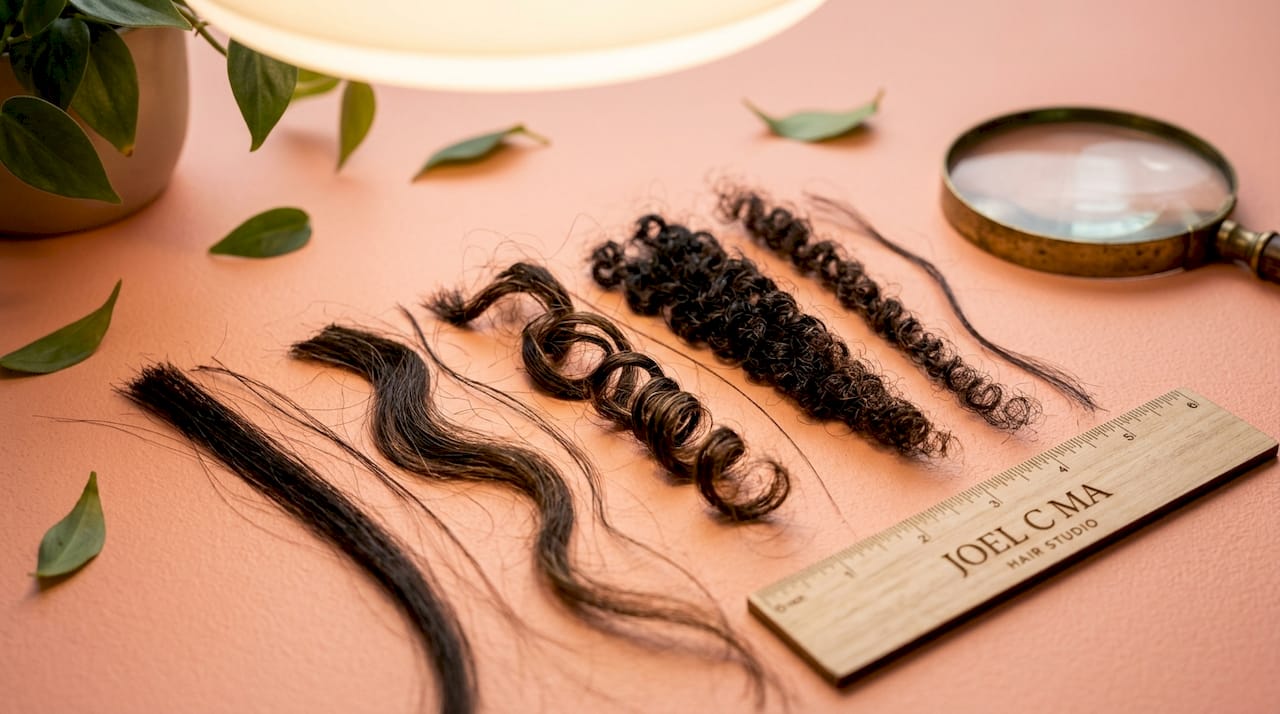
The phrase “hair texture chart” gets used loosely online, but in professional hair care it refers to two distinct classification systems working together. The first is the curl pattern system, most commonly the Andre Walker Hair Typing System, which categorizes hair from Type 1 (straight) through Type 4 (coily). The second layer is strand thickness, which describes fine, medium, or coarse hair regardless of curl. A true texture classification chart accounts for both, because a 3C coil can be fine or coarse, and those two versions need very different care.
Most confusion starts because the word “texture” gets used to describe both curl pattern and strand feel in everyday conversation. Stylists and dermatologists distinguish them as separate variables. Getting both right is what actually changes your hair results.
Breaking down the four hair types
The Andre Walker system organizes hair into four main types, each with three subcategories (A, B, C) that reflect increasing tightness or density of the curl pattern.
Type 1: Straight
- 1A: Completely flat with no wave, typically very fine and silky
- 1B: Flat at the root with slight bend at the ends
- 1C: Straight but coarser, with more body and occasional wave
Straight hair tends to get oily faster because sebum travels the strand without any curl to slow it down. The main challenge is volume and preventing limpness.
Type 2: Wavy
- 2A: Loose, tousled S-wave, easy to straighten
- 2B: More defined S-wave, prone to frizz in humidity
- 2C: Strong waves close to curls, with significant frizz potential
Wavy hair sits in an awkward middle ground. It’s not straight enough to lie flat and not curly enough to form defined spirals without help.
Type 3: Curly
- 3A: Large, loose spirals about the width of a sidewalk chalk
- 3B: Medium ringlets, springy with more definition
- 3C: Tight corkscrews or pencil-width curls with high density
Curly hair needs moisture consistently. The curl structure makes it harder for natural oils to coat the full strand, which leads to dryness and breakage at the ends.
Type 4: Coily
- 4A: Tight coils with a visible S-pattern, soft and defined
- 4B: Z-shaped or sharp angular bends, less definition
- 4C: Very tight, densely packed zigzag pattern with minimal definition
Coily hair experiences the most shrinkage and is most vulnerable to dryness and mechanical damage. The follicle shape that creates these tight coils is elliptical rather than round, which also means the strand is less structurally uniform along its length.
Pro Tip: Your curl pattern can vary across different parts of your head. Crown, nape, and temple areas often fall into different subtypes. Assess at least three zones before settling on a single type.
Understanding strand thickness (the real “texture”)
When professionals say hair texture categories, they mean the physical diameter of a single strand. Fine hair measures under 60 micrometers, medium falls between 60 and 80 micrometers, and coarse runs above 80 micrometers. These are real measurements with real consequences for how your hair behaves under heat, products, and styling stress.
Here’s how to assess your own texture at home without any special tools:
- Pull a single dry strand from your head (after washing, no products).
- Lay it next to a piece of standard sewing thread in natural light.
- If the strand looks thinner than the thread, your texture is fine. If it matches, you’re medium. If it’s thicker, you have coarse hair.
- Repeat with strands from different areas of your head since thickness can vary.
- Roll the strand between your fingers. Fine strands are barely detectable; coarse strands feel distinct and sometimes wiry.
Why does this matter? Fine hair absorbs products quickly and can go limp or greasy with heavy formulas. It’s also more fragile and breaks more easily under tension. Coarse hair resists penetration, so lightweight serums often sit on the surface without doing much. Medium hair is the most forgiving and works with a wide range of products.
Pro Tip: Never assess your texture when your hair is wet, freshly heat-styled, or loaded with product. Moisture swells the strand temporarily, and product residue changes how it feels between your fingers.
Density and porosity: the two variables most people miss
Hair density and porosity are where most generic hair guides stop short. Both of these affect how your hair looks and behaves more than most people realize. Understanding them completes your hair type guide beyond just curl and thickness.
Hair density refers to how many strands are on your head, not how thick each one is. Low density means you can easily see your scalp with a simple part. High density means the scalp is barely visible even when you pull hair apart. Medium density falls in between.
- Low density: Use lightweight, volumizing products. Heavy formulas weigh hair down and make it look flat.
- Medium density: Most products work well. Balance moisture with hold.
- High density: Use generous product amounts. Hair can handle heavier creams and butters.
Hair porosity describes how well your hair absorbs and holds moisture. The cuticle layer controls this. When cuticles lie flat and tight, water beads off initially. When cuticles are raised or damaged, water enters fast but escapes just as quickly.
| Porosity type | How water behaves | Best approach |
|---|---|---|
| Low porosity | Sits on hair, slow to soak in | Use heat (warm towel, steam) to open cuticles for absorption |
| Medium porosity | Absorbs and retains moisture well | Maintain with regular conditioning; most products work |
| High porosity | Absorbs fast, dries fast | Use sealants like oils or butters after moisturizing to lock hydration in |
To test your porosity at home, place a clean shed strand in a glass of room-temperature water. Low porosity hair floats for a while before sinking. High porosity hair sinks immediately. Medium lands somewhere between the two.
Pro Tip: Chemical treatments, heat damage, and sun exposure all raise your cuticles over time, pushing even naturally low porosity hair toward high porosity behavior. Your porosity can change. Test it again after any major chemical service.
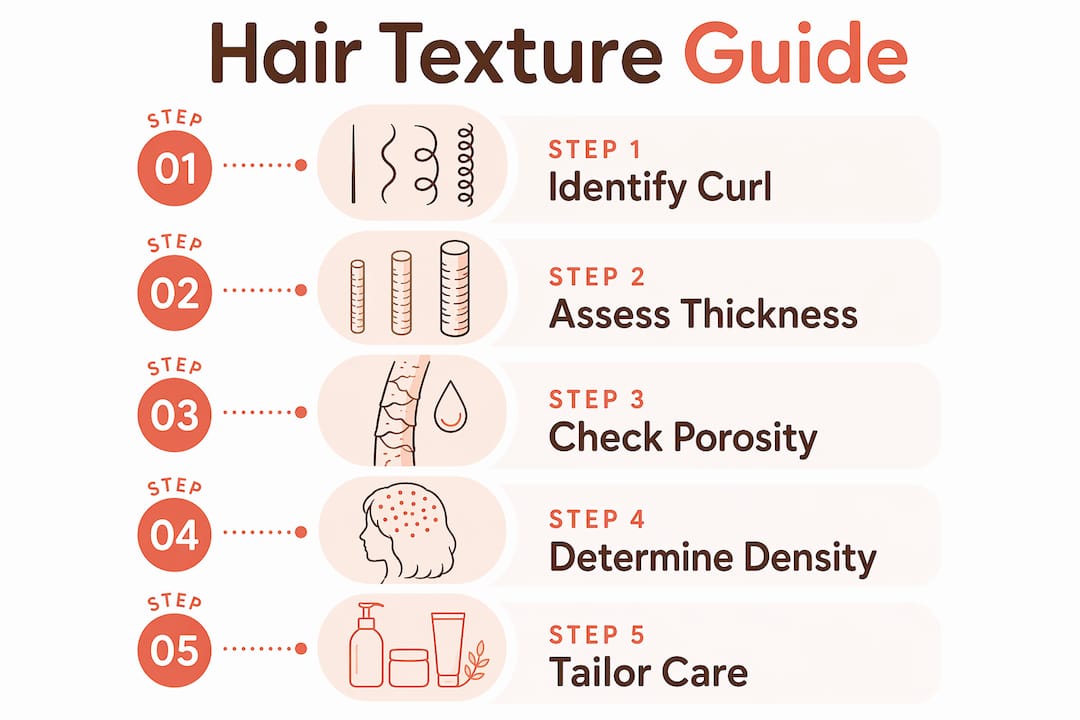
How to identify your hair profile step by step
Accurate self-assessment starts with the right conditions. Clean, product-free, air-dried hair is your only reliable baseline. Heat, styling products, and damage can all mask your natural pattern and thickness.
- Wash your hair with a clarifying shampoo and skip conditioner for this assessment.
- Let it air-dry completely without touching or scrunching.
- Look at the overall shape from root to ends. Is it straight, wavy, curly, or coily?
- Note whether the pattern holds along the full length or only at the ends.
- Pull a single strand in natural light and compare it to sewing thread for texture.
- Part hair in the middle and examine how much scalp shows. This gives you your density.
- Run the float test on a shed strand for porosity.
One critical warning: damaged hair masks your natural texture. Hair that has been over-processed, over-heated, or repeatedly bleached often looks more straight and fine than it naturally is. If your hair has significant damage, wait until at least two to three inches of new growth come in before making a full assessment.
Pro Tip: Take photos of your hair air-dried each time you assess it. This creates a visual record over time and helps you notice when your texture or pattern shifts, which can signal a change in your health, hormones, or damage history.
Applying your hair profile to real care decisions
Once you know your type, texture, density, and porosity, the product and routine decisions become logical rather than random.
- Fine hair (any type): Avoid oils and thick creams on the scalp. Use protein-based products to reinforce strength. Skip heavy conditioners on roots.
- Coarse hair (any type): Use richer, cream-based conditioners. Deep condition weekly. Products with shea butter, avocado oil, or glycerin work well.
- High porosity (curly or coily): Layer products: water-based moisturizer first, followed by a sealant like an oil or butter. Reduce wash frequency to prevent stripping.
- Low porosity (any texture): Warm your conditioner before applying. Co-washing works better than frequent shampooing.
Washing frequency is another place where texture guides the call. Washing two to three times per week is a reasonable starting point, but straight fine hair may need daily washing while dense coily hair often does better with weekly washing. Overwashing creates dryness; under-washing creates buildup. Both disrupt the scalp health foundation your hair needs to behave well.
For styling, curl pattern tells you which techniques to use. Wavy types do well with scrunch-and-air-dry methods. Curly types benefit from the LOC method (liquid, oil, cream). Coily types often need the LCO variation with cream applied before oil to seal in more moisture. Pair these with styling techniques matched to your strand thickness for the best results.
Pro Tip: Scalp care is not the same as hair care. A clean, balanced scalp that isn’t over-stripped or over-moisturized creates the foundation for manageable hair at any texture or type. Read through scalp health tips if your hair isn’t responding to even the right products.
What I’ve learned from years of seeing every hair type
I’ll be honest about something the chart-focused world gets wrong. Clients walk in with their hair typed down to the decimal, armed with product lists curated for a 3B or a 4A, and yet their hair is a disaster. The label isn’t the problem. The obsession with the label is.
Hair texture and type are dynamic, shaped by genetics but also by hormonal shifts, seasonal changes, medications, nutrition, and how you’ve treated your hair over the past year. I’ve watched clients whose hair shifted from 3B to 3C after pregnancy, or from medium to fine porosity after a full color correction. The hair that sits on your head today is the product of everything you’ve done and experienced in the last several years.
The stylists and clients I’ve seen get the best results are the ones who treat their hair profile as a living, responsive system rather than a fixed ID number. They notice when their ends start drinking up product faster than usual. They adjust their wash frequency when seasons change. They don’t fight their hair into performing like a different type. They reduce breakage risks by staying responsive to what the hair is actually telling them.
Charts are a starting point, not an endpoint. Use them to start asking better questions about your hair, not to arrive at a permanent answer.
— Joelcma
Let Joelcma match your profile to the right care
Understanding your hair profile is one thing. Acting on it with the right products and techniques is where most people need a hand. At Joel C Ma Hair Studio in La Jolla, every service starts with a personalized consultation that takes your curl pattern, strand thickness, density, and porosity into account. The team doesn’t apply a one-size approach to cuts, color, or treatments. If you want to start with products, explore the expert-curated shampoos for your hair type or browse precision haircut options tailored for your texture. Great hair starts with someone who actually looks at what you have.
FAQ
What is the difference between hair type and hair texture?
Hair type refers to your curl pattern, classified from 1A (straight) to 4C (coily) using the Andre Walker system. Hair texture refers to the physical thickness of a single strand, categorized as fine, medium, or coarse.
How do I identify my hair texture at home?
Place a single dry, clean strand next to a piece of sewing thread. If the strand is thinner than the thread, you have fine hair. If it matches, you have medium hair. If it’s thicker, you have coarse hair.
What is hair porosity and why does it matter?
Hair porosity describes how well your hair absorbs and retains moisture based on the condition of your cuticle layer. High porosity hair soaks up moisture fast but loses it quickly, requiring sealants, while low porosity hair needs heat activation to absorb products properly.
Can my hair type change over time?
Yes. Hair texture and type can shift due to hormonal changes, damage, heat, chemical treatments, and even seasonal or dietary factors. Always assess your hair on clean, undamaged, air-dried strands for the most accurate reading.
How many strands should I test to assess my texture accurately?
Test strands from at least three different areas: the crown, the nape, and one temple. Thickness can vary across zones, and testing multiple strands gives you a more accurate overall picture of your hair texture.
Recommended
- Understanding Hair Texture: The Essence of Your Style – Joel C Ma Hair Studio
- Tips for Hair Makeovers That Actually Transform Your Look – Joel C Ma Hair Studio
- How to Choose a Hair Color for a Stylish Transformation – Joel C Ma Hair Studio
- Hair Makeover: Transforming Style and Confidence – Joel C Ma Hair Studio