
Hair texture medium: Style and care guide for La Jolla
TL;DR:
- Many people misunderstand their hair’s curl pattern, but hair texture is an entirely separate trait that influences styling and product choice. Medium hair texture, with strand diameters between 60 to 80 micrometers, varies from fine to coarse and requires tailored routines based on its fine or coarse leaning within this range. Recognizing and adjusting product weights according to your specific medium hair subtype leads to better, longer-lasting styles and healthier hair.
Most people believe curl pattern tells the whole story of their hair. It doesn’t. Hair texture medium is a separate characteristic entirely, one that refers to the actual diameter of your individual strands rather than whether they’re straight, wavy, or coily. If you’ve ever followed advice labeled “for your hair type” and still ended up with limp, stiff, or unmanageable results, there’s a good chance the real culprit was a mismatch between your strand thickness and the products you were using. This guide breaks down what medium hair texture actually means, how to identify it, and how to style and care for it in a way that truly works.
Table of Contents
- What is medium hair texture and how to identify it
- Why hair texture matters more than curl pattern alone
- The medium hair spectrum: Leaning fine vs. leaning coarse
- Practical hair care and styling tips for medium texture hair
- Common challenges with medium hair texture and how to overcome them
- Rethinking medium hair texture: Why one-size-fits-all doesn’t work
- Discover personalized medium hair care at Joel C Ma Hair Studio in La Jolla
- Frequently asked questions
What is medium hair texture and how to identify it
Let’s start with the right definition of hair texture. Hair texture refers to the physical diameter of a single strand of hair, not its shape or curl pattern. It’s measured at the strand level, and it determines how much product a strand can absorb, how heavy it feels, and how well it holds a style.
Medium hair texture strand diameter ranges from 60 to 80 micrometers, placing it squarely between fine (under 60µm) and coarse (over 80µm). In practical terms, a medium strand feels similar to a soft piece of sewing thread when you roll it between your fingers. It has some presence without feeling thick or wiry.
How to identify medium hair texture at home:
- Pull a single clean strand from your brush or scalp
- Hold it next to a strand of standard cotton sewing thread
- If your hair feels roughly the same as the thread, neither whisper-thin nor noticeably thicker, you likely have medium hair texture
- Fine hair will feel almost invisible; coarse hair will feel noticeably thicker
The critical point when you understand hair texture is that this measurement applies independently to every person, regardless of whether their hair is pin-straight or tightly coiled. Medium-textured hair can be straight, wavy, or curly. Two people with very different curl patterns can share the exact same hair texture category.
| Feature | Fine hair | Medium hair | Coarse hair |
|---|---|---|---|
| Strand diameter | Under 60µm | 60–80µm | Over 80µm |
| Feel between fingers | Almost invisible | Soft thread | Noticeable thickness |
| Product tolerance | Very light only | Flexible, wide range | Rich, heavy products |
| Volume tendency | Easily flattened | Balanced | Naturally fuller |
| Style hold | Shorter duration | Moderate to long | Long-lasting |
Now that you know what medium hair texture is and how to identify it, let’s explore why this matters beyond just measurement.
Why hair texture matters more than curl pattern alone
Here’s where most hair care advice goes wrong. The mainstream conversation fixates on curl pattern. Type 2A, 3B, 4C. These labels have value, but they don’t tell you how your hair will actually respond to products or a particular cut. Hair texture and curl pattern are treated as separate variables, and product decisions shouldn’t be based on curl shape alone.
Imagine two people, both with Type 2B wavy hair. One has fine strands, and the other has medium strands. The fine-textured person will get weighed down by a curl-enhancing cream that works beautifully for the medium-textured person. Same curl pattern. Completely different results. That’s why the role of hair texture in styling deserves its own conversation.
Why hair texture is the real decision-maker:
- It determines how much moisture your strand can hold before feeling saturated
- It affects how quickly your hair air-dries
- It influences how long a blowout or a curl actually lasts
- It guides the right amount of product to apply, not just the type
- It shapes which haircut layering technique will add volume or control
Pro Tip: Next time a product disappoints you, check the formulation weight before blaming the brand. A medium-weight leave-in that works for a friend with fine hair may be underwhelming for someone at the coarser end of medium. The product may be excellent, just wrong for your specific strand diameter.
Understanding why hair texture matters leads us to the nuanced behaviors within the medium hair category.
The medium hair spectrum: Leaning fine vs. leaning coarse
Medium hair is not a single fixed point. It’s a range, and where you sit within that range changes everything about how you should care for your hair. Medium hair includes “medium leaning fine” at around 60µm, which prefers lighter products, and “medium leaning coarse” at around 80µm, which tolerates richer conditioners and oils without going limp.
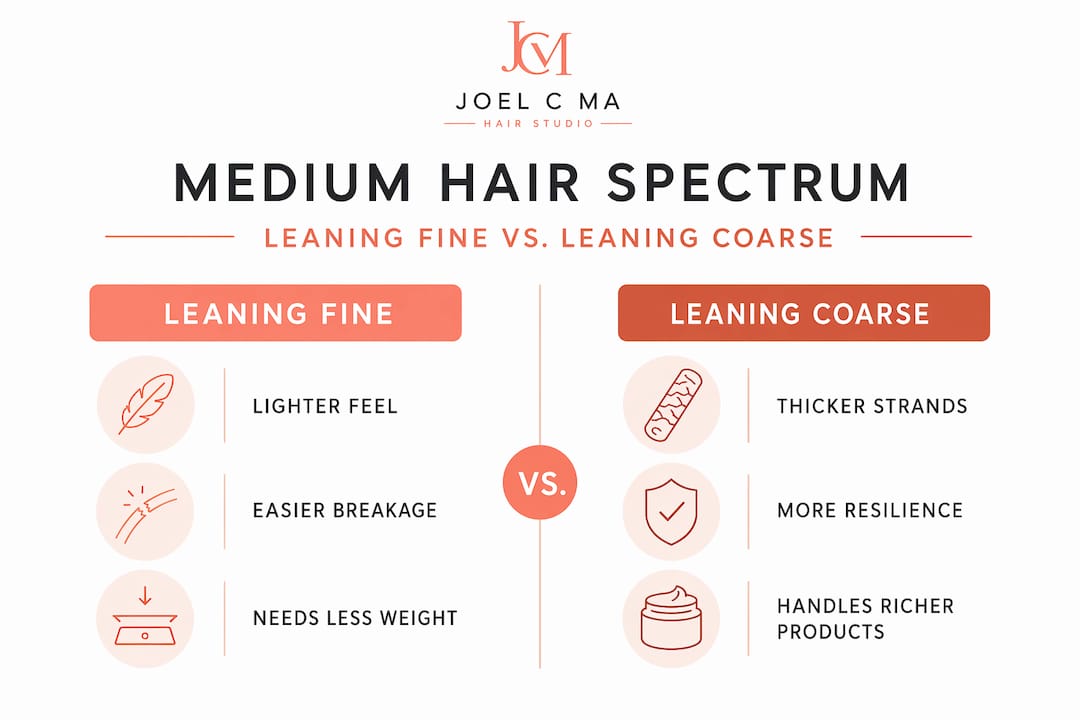
| Subtype | Approx. diameter | Best product weight | Common challenge | What to avoid |
|---|---|---|---|---|
| Medium leaning fine | ~60µm | Lightweight creams, water-based serums | Product buildup, limpness | Heavy butters, thick oils |
| Medium leaning coarse | ~80µm | Richer conditioners, cream stylers | Dryness, frizz | Ultra-lightweight serums only |
This distinction matters especially in coastal climates like La Jolla, where ocean humidity and dry Santa Ana winds can push your hair’s behavior in opposite directions depending on the season. A medium leaning coarse strand may feel perfectly moisturized in winter but call for a heavier conditioner during dry fall winds.
Signs you lean toward the finer end of medium:
- Products leave hair looking flat or greasy within hours
- Hair loses volume quickly after washing
- Lightweight mousses or foams work better than creams
- Your strand feels barely there when rolled between fingers
Signs you lean toward the coarser end of medium:
- Hair drinks up conditioner without feeling heavy
- Frizz and dryness are more common complaints than limpness
- Cream-based stylers hold better than gels or lightweight sprays
- Your strand has a clear, tangible presence between your fingers
Pro Tip: Do the thread test in different seasons. Your hair may behave more like medium leaning fine in summer humidity and shift toward needing richer products in dry winter months. Update your routine accordingly rather than sticking to one fixed regimen all year.
Explore the types of hair texture beyond medium to see how your texture compares with others and refine your self-assessment.
With this understanding of medium hair nuances, let’s explore practical care and styling tips tailored to medium-textured hair.
Practical hair care and styling tips for medium texture hair
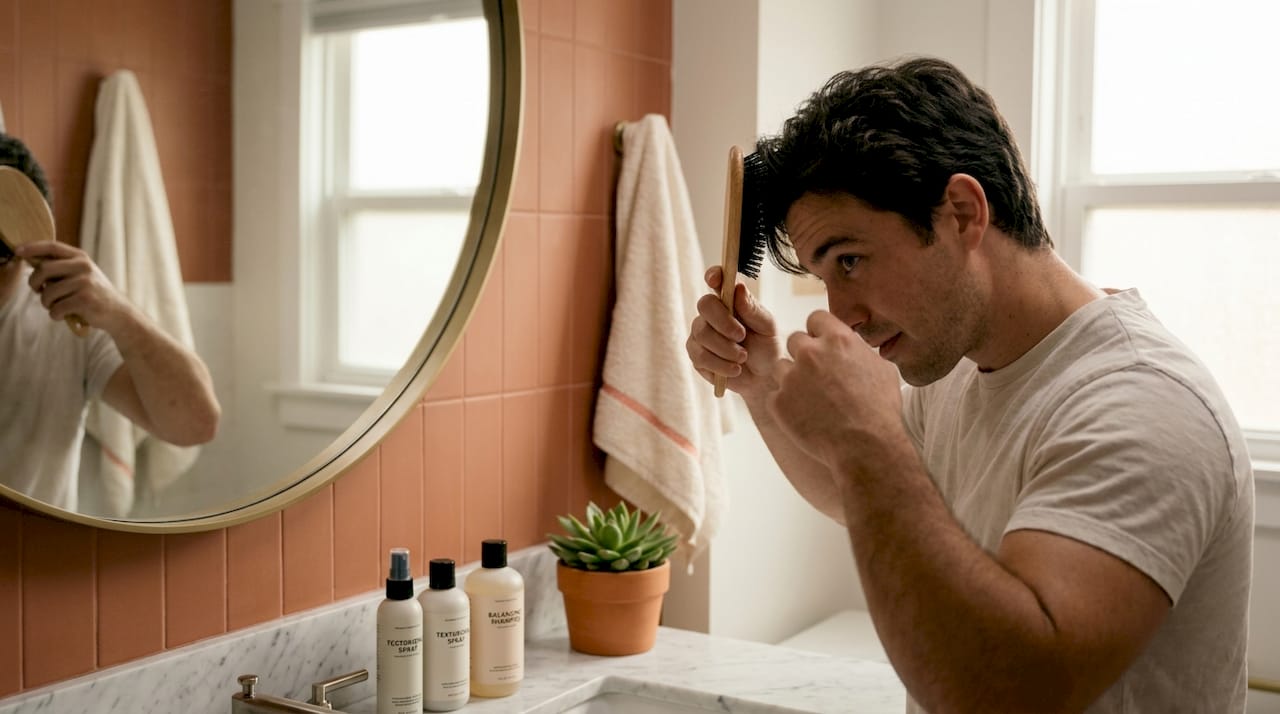
The good news: medium hair tolerates most product types without either weighing down or drying out, giving you more flexibility than fine or coarse hair types. The challenge is using that flexibility deliberately rather than defaulting to random trial and error.
Step-by-step product approach for medium-textured hair:
- Start with a clarifying shampoo once a week to remove buildup, especially if you use styling products regularly
- Apply a medium-weight conditioner from mid-length to ends, avoiding the scalp
- While hair is damp, use a lightweight leave-in conditioner or cream styler as your base layer
- Add a small amount of argan oil (no more than a few drops) for shine and frizz control, focusing on the ends
- Choose a flexible-hold hairspray for finishing rather than maximum-hold formulas, which stiffen strands
- Adjust product volume based on whether your hair leans fine or coarse, not just the instructions on the label
Best products for medium hair by subtype:
- Medium leaning fine: Water-based serums, lightweight mousse, foam volumizers, spray leave-ins
- Medium leaning coarse: Cream stylers, rich leave-in conditioners, light hair oils, curl-enhancing butters in small amounts
- Both subtypes: Medium-weight argan oil, flexible-hold spray, sulfate-free shampoo
Daily hair care routines for medium hair should account for how often you style with heat, how much time you spend outdoors in La Jolla’s sun and salt air, and how frequently your hair becomes oily between washes.
Pro Tip: If you can only make one change to your routine, swap your heavy conditioner for a medium-weight version. It’s the single adjustment that helps the widest range of medium hair subtypes without needing a complete product overhaul.
Common challenges with medium hair texture and how to overcome them
Even with the right information, medium-textured hair comes with its own set of recurring frustrations. The good news is that most problems trace back to one source: product mismatch, especially selecting wrong weights, is the main reason styling doesn’t work for medium hair.
Most common challenges and their real causes:
- Limp, flat hair after styling: Usually caused by using products designed for coarse hair on medium leaning fine strands
- Dry, rough texture despite regular conditioning: Medium leaning coarse hair being under-nourished with serums meant for fine hair
- Inconsistent results day to day: Heat styling or seasonal changes shifting your strand’s position on the medium spectrum
- Buildup that dulls color or curl definition: Over-applying even lightweight products without regular clarifying washes
- Misreading texture as curl pattern: Leading to curl-type products that address shape but not diameter
“The first salon diagnostic is checking if product weight matches your particular medium hair subtype.”
This is exactly what separates a generic routine from one that actually works. Professional stylists use strand-weight diagnostics, physically feeling your hair, examining how it responds to moisture, and watching how it behaves after product application. You can replicate a simplified version at home using the thread test combined with a one-week product experiment.
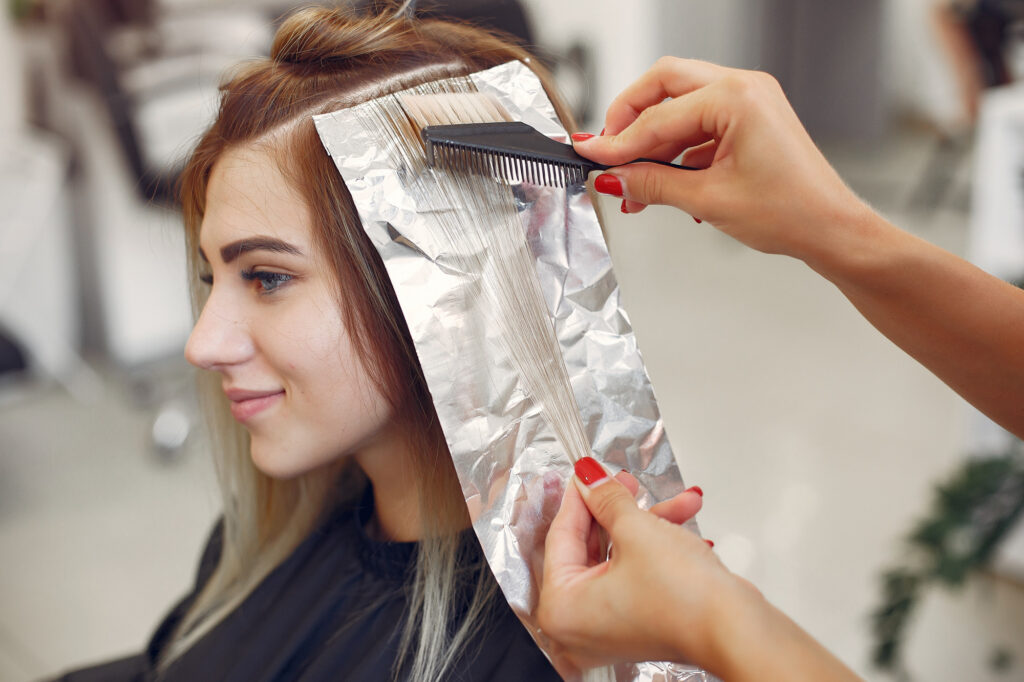
If your medium hair behaves differently after a vacation, a color treatment, or a change in seasons, that’s completely normal. Chemical services like balayage or highlights can temporarily shift your strand’s behavior toward a finer feel, which is why tailored styling for medium hair after color work often calls for a slightly lighter product hand than before.
Rethinking medium hair texture: Why one-size-fits-all doesn’t work
After more than 25 years of working with hair in environments as specific as La Jolla’s coastal climate, here is the clearest truth we can offer: medium hair is the texture category most likely to be under-served by generic advice. Precisely because it sits in the middle, routine recommendations for medium hair tend to average out in ways that help no one specifically.
Many experts treat medium texture as a spectrum requiring nuanced product weight adjustments rather than a single routine, and applying this insight unlocks superior styling outcomes. But most product labels and online guides still treat it as one fixed thing.
La Jolla’s environment adds another layer. The marine layer in the morning can swell strands with moisture, while afternoon sun and dry offshore winds can strip that moisture away by the evening. Medium leaning coarse hair may need a richer leave-in during winter, then a lighter version when June Gloom settles in and humidity climbs. Treating your routine as fixed all year means you’re almost always behind the conditions your hair is actually experiencing.
The clients who get the most out of their customized hair styling are the ones who stop trying to find “the one perfect routine” and start treating their hair as something that responds to conditions. They keep two or three product weights on hand. They do the thread test seasonally. They check in with their stylist not just when something goes wrong, but when something changes, a new climate, a new service, a new stress level that’s affecting hair growth and texture.
Medium hair’s greatest strength is also its greatest trap. Its flexibility means it can make almost anything work well enough, which makes it easy to never discover what works brilliantly.
Discover personalized medium hair care at Joel C Ma Hair Studio in La Jolla
Understanding your medium hair texture is the first step. Applying that knowledge with precision is where the real transformation happens.
At Joel C Ma Hair Studio in La Jolla, every consultation starts with a hands-on strand assessment to identify exactly where your hair sits on the medium texture spectrum. From there, the team builds a styling and product plan around your specific subtype, your lifestyle, and La Jolla’s seasonal climate. Whether you’re navigating a fresh balayage, a new cut, or just years of product frustration, the studio’s customized hair styling approach gives you a clear, personalized path forward. Pair that with guidance on daily hair care routines and access to expert-curated products, including the best salon shampoos for colored hair, and you have everything needed for genuinely manageable, stylish medium-textured hair.
Frequently asked questions
How can I tell if my hair texture is medium?
Compare a single clean strand of your hair to a standard cotton sewing thread. If the strand feels like a soft thread similar in thickness, it’s likely medium textured, neither too wispy nor noticeably thick.
Does hair texture affect which styling products I should use?
Yes, strongly. Matching product weight to strand thickness prevents limpness or dryness, and within medium hair specifically, whether you lean finer or coarser determines the right product weight.
Is hair texture the same as curl pattern?
No. Hair texture and curl pattern are separate traits entirely. Texture measures strand diameter, while curl pattern describes strand shape, and you can have any combination of the two.
Why does my medium-textured hair sometimes feel limp with products?
This usually means your product weight is too heavy for your subtype. Medium leaning fine hair tends to be weighed down by rich butters and heavy oils, which cause that limp, flat feeling even when the product is high quality.
Can medium-textured hair handle heat styling tools?
Yes, with appropriate precautions. Medium hair heat tolerance ranges around 350 to 380 degrees Fahrenheit, higher than fine hair but lower than coarse, so use heat protectants and moderate temperature settings for best results.
Recommended
- Hair texture explained: your guide to tailored styling – Joel C Ma Hair Studio
- Expert hair styling techniques for your unique look in La Jolla – Joel C Ma Hair Studio
- Hairstyle inspiration for women: Elegant looks and expert tips – Joel C Ma Hair Studio
- How to manage frizzy hair in La Jolla for smoothness – Joel C Ma Hair Studio