
Hair texture explained: your guide to tailored styling
TL;DR:
- Hair texture describes strand thickness (fine, medium, or coarse), which is separate from curl pattern and affects styling outcomes. Understanding both hair type and texture helps in selecting the right products, techniques, and appointments for lasting, personalized results. Proper assessment involves natural, product-free drying and careful observation of strand feel and shape.
Most style-savvy people in La Jolla walk into a salon knowing their curl pattern but drawing a complete blank on their actual hair texture. That single gap leads to wrong product choices, frustrating styling results, and services that never quite deliver what the inspiration photo promised. Hair texture and hair type are two different measurements that work together, and understanding both is the difference between a look that holds all day and one that falls flat by noon. This guide breaks down exactly what texture means, how to identify yours, and how to use that knowledge for consistently better hair days.
Table of Contents
- Defining hair texture: the basics and why the confusion matters
- How texture and type work together: the expert framework
- Controversies and evolving science: beyond visual categories
- Applying your texture knowledge: personalized haircare and styling
- Expert perspective: why texture-first thinking transforms your style
- Personalized hair artistry: your next step in La Jolla
- Frequently asked questions
Key Takeaways
| Point | Details |
|---|---|
| Texture vs. type | Hair texture refers to strand thickness, while hair type means curl shape. |
| Personalized routine benefits | Knowing your exact texture and type results in less product waste and better hair days. |
| Assessment method | Identify texture by feel and type by observing clean, air-dried hair. |
| Science update | Modern studies are redefining hair texture and formation with more precise measurements. |
| Pro results | Expert stylists use both texture and type to create truly custom styles. |
Defining hair texture: the basics and why the confusion matters
Now that we’ve pinpointed the common confusion, let’s lay out what hair texture actually means.
When most people say “texture,” they’re picturing wavy, curly, or coily hair. That’s actually hair type, which refers to the shape or curl pattern of the strand. Hair texture means something different: it describes the diameter or thickness of each individual strand, typically categorized as fine, medium, or coarse.
According to strand thickness research, hair texture refers to the thickness and diameter of individual strands, described as fine, medium, or coarse, and this is entirely distinct from hair type, which addresses curl pattern. A fine strand is physically narrower than a coarse one, regardless of whether it’s straight, wavy, or tightly coiled.
Here’s why that distinction matters so much in practice:
- Fine-textured hair is more fragile, absorbs products quickly, and gets weighed down by heavy creams or oils.
- Medium-textured hair is the most versatile, holding styles reasonably well without excessive product.
- Coarse-textured hair has the widest diameter, tends to be stronger, but needs richer moisture to stay pliable and smooth.
- Hair type (straight, wavy, curly, coily) tells you about the pattern but says nothing about how much protein a strand can handle or how quickly it absorbs moisture.
“Using a product designed for ‘curly hair’ without accounting for strand thickness is like buying shoes based only on style. The fit still has to match.” — Joel C Ma Hair Studio
The most common real-world mistake? Copying a routine from someone with your identical curl pattern but a completely different strand diameter. You apply their go-to curl cream, and suddenly your hair looks greasy and flat. Their strands are coarse; yours are fine. Same type. Completely different texture. That’s the gap we need to close.
How texture and type work together: the expert framework
With those definitions set, it’s time to look at how experts actually identify and use both texture and type together in the real world.
Understanding types of hair texture alongside curl formation gives you a complete hair profile. Think of it as coordinates on a map: one axis is texture (fine/medium/coarse), the other is type (straight/wavy/curly/coily). Your exact location on that map determines your ideal products, techniques, and styling approach.
Common hair profile combinations
| Hair type | Fine texture | Medium texture | Coarse texture |
|---|---|---|---|
| Straight | Flat, fragile, needs volume | Balanced, easy to style | Resistant, needs smoothing products |
| Wavy | Loses definition fast | Holds waves well | Strong waves, frizz-prone |
| Curly | Delicate curls, prone to breakage | Defined, resilient coils | Dense, needs deep moisture |
| Coily | Very fragile, high shrinkage | Versatile, absorbs moisture | Strong, coils need rich products |
Even the most knowledgeable stylist will consider both columns before recommending anything. Two clients can both have Type 3A curls and still need entirely different approaches based on hair texture and formation profiles.

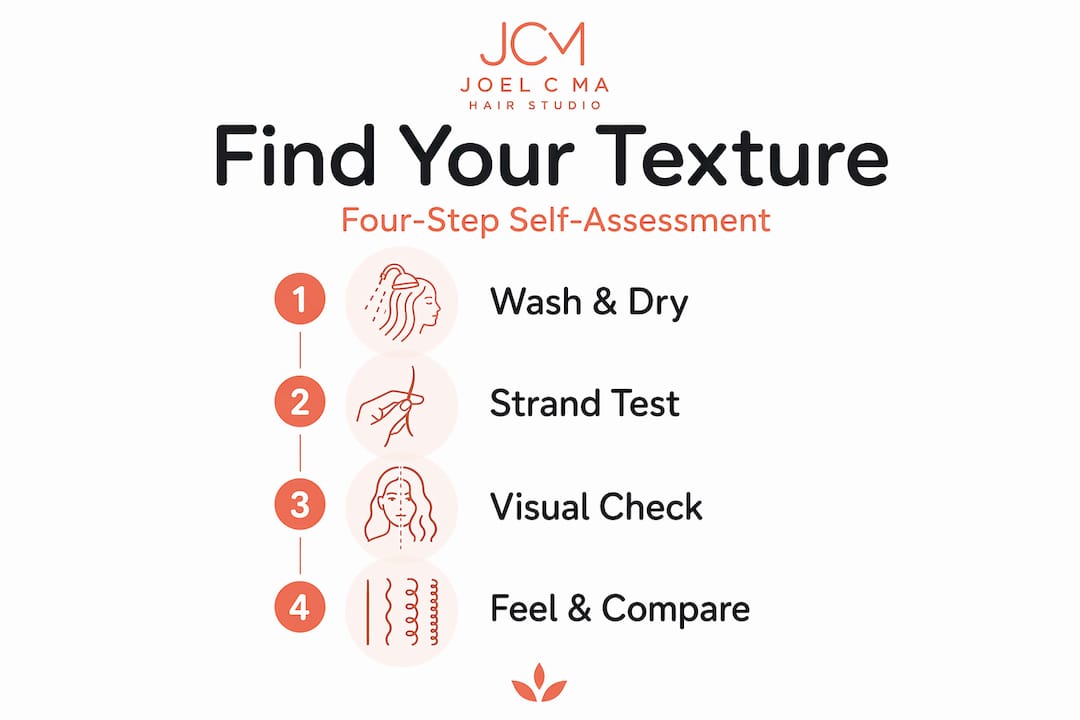
How to assess your own texture and type in four steps
A practical methodology from expert hair guides recommends identifying texture by strand feel and width, and formation by air-drying clean, product-free hair. Here’s that process broken down:
- Wash and rinse thoroughly. Use a clarifying shampoo to remove all buildup, and skip conditioner and styling products entirely.
- Air dry completely. This is non-negotiable. Blow-drying or diffusing will alter the natural curl pattern and make accurate typing nearly impossible.
- Pull out a single strand and hold it up. If you can barely feel it between your fingertips, that’s fine texture. If it feels like a piece of thread with some rigidity, that’s coarse. Anything in between is medium.
- Observe your dry, product-free shape. Is the strand completely straight, forming an S-wave, making a defined curl, or coiling tightly? That’s your type.
Pro Tip: Do this assessment in natural lighting near a window. Artificial light can mask the true shape and surface quality of each strand, making it harder to judge accurately.
The reason this step-by-step process matters is that many people assess their hair while it still has product memory from previous styling sessions. A curl cream can make straight-textured hair appear to have waves. A heavy oil can make fine strands look medium-weight. Starting fresh gives you the most accurate read.
Controversies and evolving science: beyond visual categories
While most guides and stylists use visual categories, the conversation doesn’t end there. Let’s examine where science is taking hair texture assessment.
The widely used four-type system (Types 1 through 4, with subcategories A, B, and C) has been criticized for being overly subjective and difficult to apply consistently. A person’s self-diagnosed “3B” curl in Seattle might be classified as “3C” by a stylist in Miami. Lighting, humidity, and personal interpretation all shift the result.
More rigorous researchers are pushing for quantitative classification systems, arguing that hair typing is controversial and that objective geometric measures of curl patterns are needed to replace purely visual categories. These approaches measure actual strand diameter in micrometers, the radius of curvature in a curl, and the number of waves per centimeter.
How current classification systems compare
| System | Categories | Basis | Limitation |
|---|---|---|---|
| 4-type visual system | Types 1 to 4 (A/B/C) | Observer’s visual judgment | Highly subjective, inconsistent |
| L’Oréal geometric model | 8 types | Curl radius and strand shape | Requires lab equipment |
| Quantitative PMC model | Continuous scale | Measured strand geometry | Not yet consumer-ready |
| Combined profile (type + texture) | Fine/med/coarse + type | Practical salon assessment | Best current real-world tool |
“A truly objective hair classification system would remove the guesswork and let both stylists and clients communicate with precision, rather than relying on curved lines drawn on a chart.” — Hair science research perspective
The takeaway for you as a client in La Jolla? Your self-assessed type is a useful starting point, but it’s not carved in stone. Mixed patterns across different parts of the scalp are extremely common, meaning the crown might behave like a different type than the nape. The role of hair texture in styling decisions becomes even more critical when you factor in these inconsistencies, because texture (strand diameter) tends to be more uniform across the scalp than curl pattern.
Science is also beginning to map how chemical processes, heat damage, and aging alter both the diameter and the cross-sectional shape of hair strands. Color-treated hair, for example, may become porous in ways that make fine strands behave as though they’re even finer. Bleached coarse hair can shift toward medium behavior after repeated lifting. Your texture profile today may not be identical to what it was three years ago.
Applying your texture knowledge: personalized haircare and styling
So how do you use this knowledge for fantastic hair days, every day? Let’s get practical.
The same curl pattern, or hair type, can exist with different strand thickness, and a routine that works perfectly for someone with the same curl category may completely fail if their strands are substantially finer or coarser. This is one of the most underappreciated facts in the world of personalized haircare.
Practical steps for translating your texture profile into better decisions
- Communicate your full profile to your stylist. Instead of saying “I have curly hair,” say “I have fine-textured, Type 3A curls.” That one sentence gives your stylist significantly more to work with when recommending a cut, a color approach, or a styling technique.
- Match product weight to strand diameter. Fine-textured strands need lightweight serums, foams, and sprays. Coarse-textured strands handle and often need butter-rich creams, heavier oils, and protein-rich masks.
- Adjust your heat settings accordingly. Fine strands process faster and need lower temperatures. Coarse strands may need higher heat to style effectively, but that also means stronger heat protection.
- Revisit your routine seasonally. La Jolla’s coastal humidity affects texture behavior differently depending on strand diameter. Fine strands lose volume in humidity; coarse strands tend to expand and frizz.
Pro Tip: Before your next salon visit, take a photo of your hair on a natural, product-free day. That single image communicates more texture and type information to your stylist than most clients convey in an entire consultation.
Here’s a quick breakdown of common texture-based mistakes and their fixes:
- Mistake: Applying a thick curl cream to fine-textured waves. Fix: Switch to a lightweight curl-enhancing foam or mousse.
- Mistake: Using a volumizing spray on coarse, straight strands. Fix: Use a smoothing serum or a light cream to tame and define instead.
- Mistake: Skipping protein treatments because “my curl type doesn’t need them.” Fix: Assess your texture. Fine strands almost always benefit from protein support, regardless of curl pattern.
- Mistake: Copying influencer routines without checking their texture. Fix: Always look for stylists or creators who share both their texture and type before applying their advice.
Understanding what texturizing hair actually means in a professional context also helps you make smarter salon requests. Texturizing techniques work very differently on fine strands versus coarse ones, and knowing your diameter helps you understand which approaches will give you movement without sacrificing density. Similarly, when browsing humidity proof hairstyles, matching those recommendations to your texture profile rather than just your type makes those styles dramatically more reliable in real coastal conditions.
Expert perspective: why texture-first thinking transforms your style
Here’s an honest observation from more than 25 years of working with hair in a range of environments and with clients from all walks of style: the clients who make the fastest, most satisfying progress are almost never the ones who arrive knowing their curl type. They’re the ones who understand their strand thickness.
Curl type is visible. Anyone can look in the mirror and say “I have wavy hair.” But texture requires you to actually feel your hair with intention, which most people never do. They rely on product labels, influencer routines, and generic salon advice that all skips the most fundamental variable.
The role hair texture plays in styling is what we call the “invisible layer” of great hair. When a cut falls beautifully on one client but looks completely off on another with an almost identical style, texture is almost always the missing explanation. Fine strands need weight removed strategically to avoid limpness. Coarse strands need length and some mass to avoid a triangular, top-heavy silhouette.
The most costly hair mistakes we see, including botched color results, haircuts that grow out awkwardly, and styling routines that never quite work, almost always trace back to a decision made without accounting for texture. The good news is that once you know your texture profile and start communicating it clearly, every service becomes more predictable, more successful, and genuinely more personalized to you.
Personalized hair artistry: your next step in La Jolla
Ready to put your texture insights to work? Here’s how an expert touch takes your style even further.
At Joel C Ma Hair Studio, every service begins with an assessment of both texture and type, because that’s the only way to deliver results that are truly tailored. Our approach to personalized styling consultations means you’re never handed a one-size-fits-all recommendation.
Whether you’re interested in a precision cut designed around your strand diameter, a balayage technique customized for your texture’s porosity, or a complete styling overhaul, our team of skilled hair artists blends over 25 years of experience with a genuine love for artistry in hairstyling. Book a consultation at our La Jolla studio and leave with a clear, actionable hair profile and a service plan built entirely around who your hair actually is.
Frequently asked questions
Is hair texture genetic or can it change over time?
Most aspects of hair texture are genetic, but health, aging, hormonal shifts, and chemical treatments can cause noticeable changes in strand diameter and behavior over time.
How do I know if I have fine, medium, or coarse hair texture?
Assess the width and feel of a single strand: fine feels barely-there like silk thread, coarse feels rigid and wiry, and medium sits in between. According to strand thickness categories, these three categories reflect actual differences in individual hair strand diameter, not just how your overall hair feels as a mass.
Can my hair have more than one texture or type?
Yes, mixed hair patterns and varied textures across different scalp regions are very common, which is why a thorough section-by-section assessment gives the most accurate picture.
Why do products work differently for people with similar curl patterns?
Strand thickness is the key variable. As research confirms, the same curl pattern can exist alongside very different strand diameters, and that texture difference determines how quickly a product absorbs, how much weight a strand can carry, and how a finished style holds throughout the day.