
Hair Coloring Terminology: A Stylist’s Guide for Every Level
TL;DR:
- Hair coloring terminology provides a structured language that describes shades, techniques, and finishes, reducing salon miscommunication.
- Understanding levels, tones, and techniques enables clients to participate actively in their color decisions and protects their hair health.
Hair coloring terminology is the specialized vocabulary that describes hair color shades, application methods, and finishing processes. Without it, conversations between clients and colorists collapse into vague descriptions like “make it lighter” or “more natural,” which produce unpredictable results. Hair color terms fall into four distinct categories: shade family, technique, effect, and finish or service. Knowing which category a term belongs to prevents the most common salon miscommunication. Brands like Wella Professionals and L’Oréal Paris have built entire product lines around this vocabulary, and understanding it puts you in control of every color decision.
What is hair coloring terminology and why does it matter?
Hair coloring terminology is the structured language colorists use to specify shade depth, hue direction, application method, and finishing treatment. Think of it as a two-part system: product terms describe what goes on your hair, while technique terms describe how it gets there. Terminology confusion most often arises when people interpret techniques as product types or vice versa. Asking for “balayage” when you actually want a specific shade of blonde is a classic example of this mix-up.
Understanding this vocabulary also protects your hair. A client who knows the difference between a 20-volume and 40-volume developer can have an informed conversation about damage risk before the appointment starts. The hair coloring definition covers the full spectrum of color types, from permanent to semi-permanent, and each type carries its own set of terms. Mastering even the basics puts you ahead of most salon clients.
What are hair color levels and tones, and how do they define your shade?
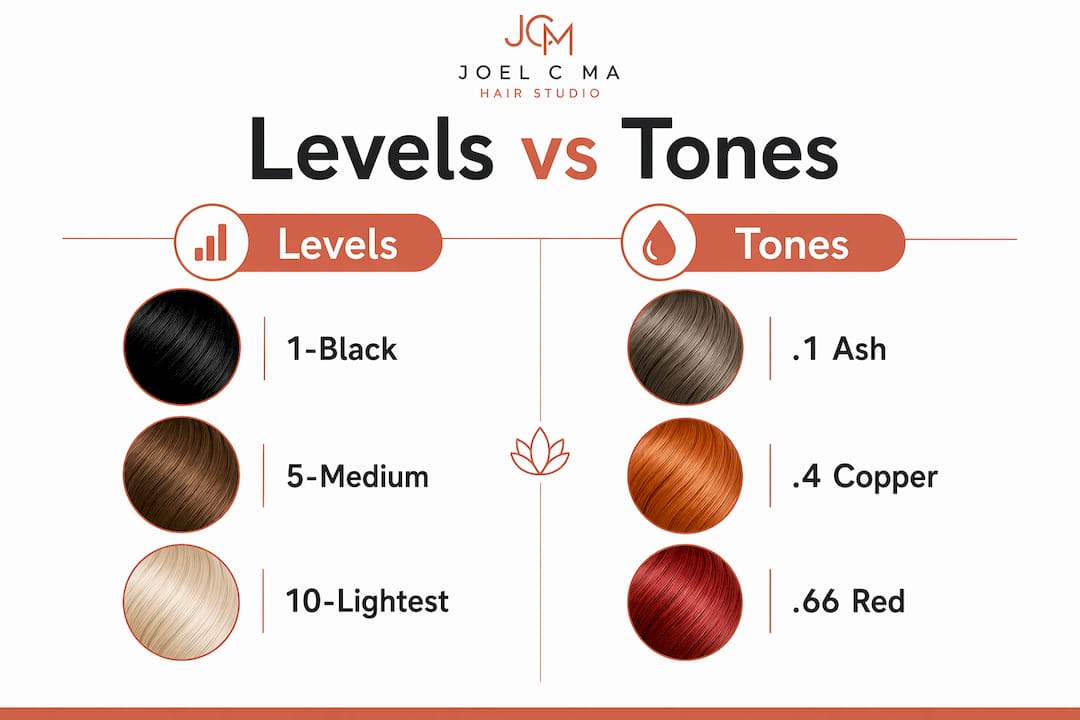
The level system is the foundation of all professional hair color communication. Hair color levels range from 1 (black) to 10 (lightest blonde), with each number representing a measurable degree of lightness or darkness. A level 4 is a medium brown, a level 7 is a medium blonde, and a level 9 is a very light blonde. Lower numbers absorb more light; higher numbers reflect it.
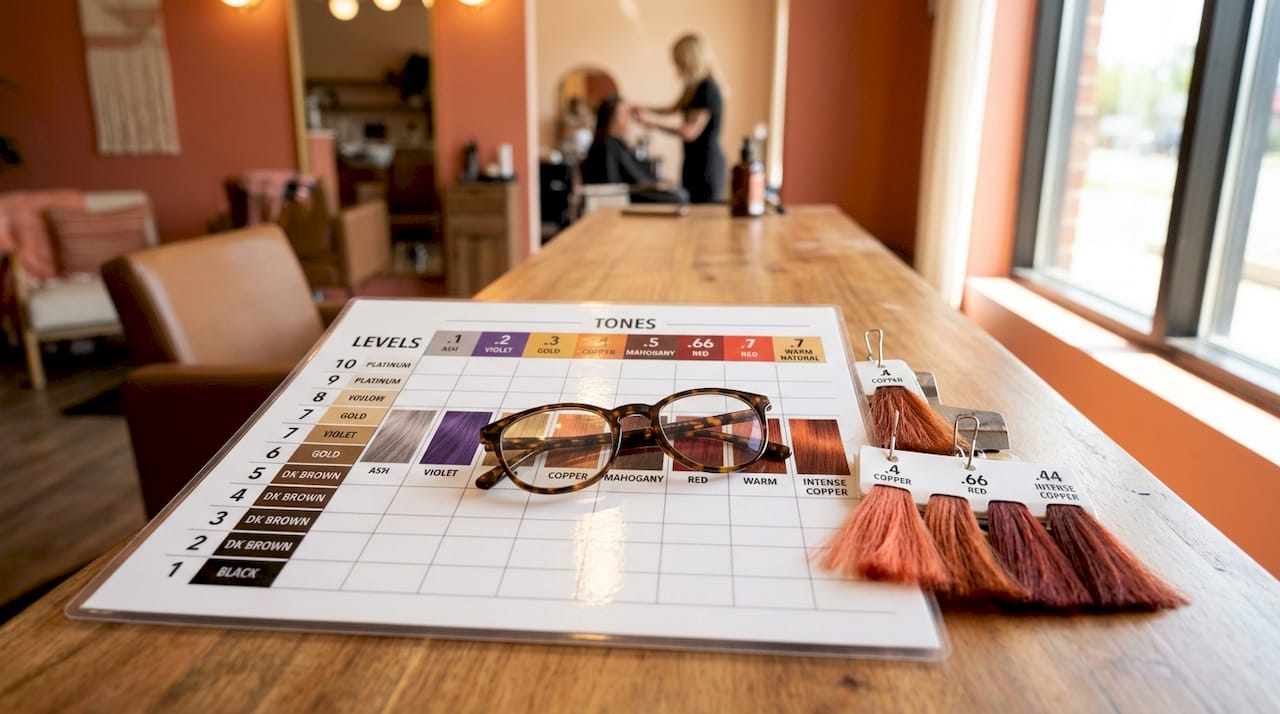
Tone codes work alongside levels to specify the hue direction of a shade. Tone codes like .1 (ash), .4 (copper), and .66 (red) indicate whether a color reads warm, cool, or neutral. A colorist writing “6.13” is specifying a dark blonde with an ash and pearl undertone, which is a precise instruction that leaves no room for guesswork. That two-part code is the difference between “I want a cool dark blonde” and actually getting one.
How level and tone combine in practice
The table below shows how level and tone notation works across common shade requests:
| Level | Tone code | Resulting shade description |
|---|---|---|
| 4 | .0 | Natural medium brown |
| 6 | .13 | Dark blonde with ash/pearl finish |
| 7 | .4 | Medium blonde with copper warmth |
| 9 | .1 | Very light ash blonde |
| 10 | .0 | Lightest natural blonde |
Skin undertones interact directly with tone selection. Cool, pink-toned skin typically flatters ash and pearl tones (.1, .13), while warm, golden skin reads best against copper and golden tones (.4, .3). Your natural hair level also determines how much lift a formula needs to reach the target level, which connects directly to developer choice.
Pro Tip: Ask your colorist to write down the level and tone code of your current color at the end of each appointment. That number becomes your reference point for every future service and prevents the “I don’t remember what we used last time” problem.
How do different hair coloring techniques affect the final look?
Technique determines where color is placed on the hair, which controls dimension, contrast, and how naturally the color grows out. Balayage is a hand-painted method that deposits color directly onto the hair surface without foils, producing a soft, blended, sun-kissed effect. Because the color is painted freehand, the result is unique to each client’s hair texture and growth pattern. This is why two people can both request balayage and walk out looking completely different.
Here is a breakdown of the most common hair coloring techniques and what each one delivers:
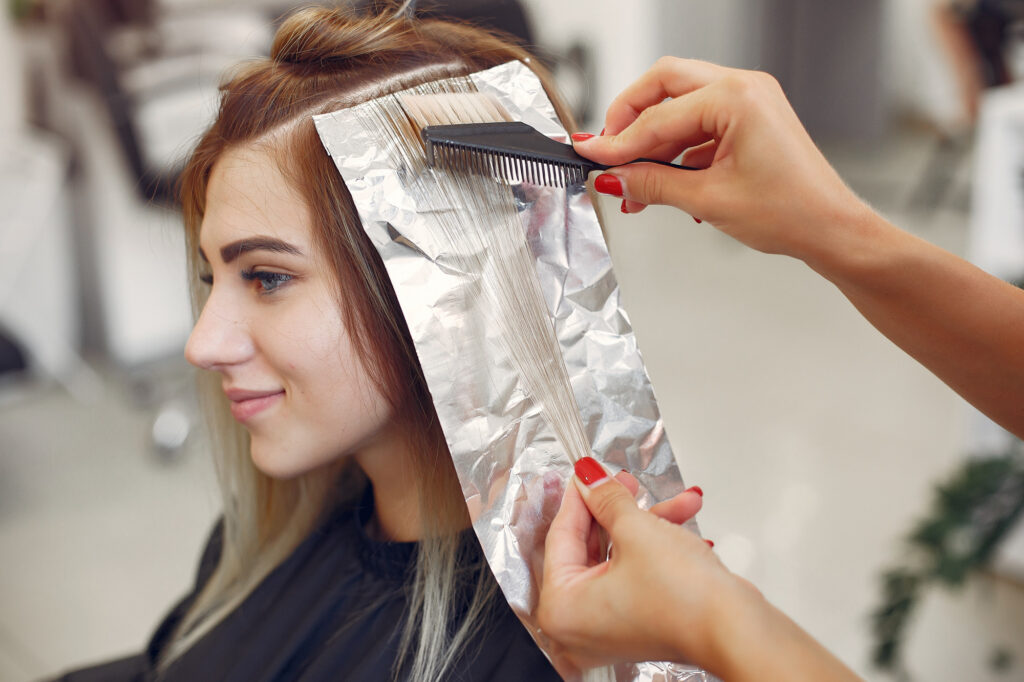
- Traditional highlights: Color applied to fine sections and wrapped in foil for maximum lift and contrast. The foil creates heat, which accelerates processing and produces brighter, more defined results than open-air techniques.
- Babylights: Ultra-fine highlight sections that mimic the natural color variation of a child’s hair. The sections are smaller than standard highlights, which creates a subtler, more dimensional effect.
- Ombré: A gradient effect where color transitions from darker roots to lighter ends. The contrast between root and tip is intentional and visible. For a detailed ombré vs. balayage comparison, the key distinction is that ombré is a defined gradient while balayage is a blended placement technique.
- Sombré: A softer version of ombré where the transition between dark and light is gradual rather than stark. The name combines “soft” and “ombré.”
- Root shadow: A darker color applied at the root to add depth and create a natural grow-out appearance. Often used to soften the contrast between colored hair and natural regrowth.
- Color melt: A blending technique that connects two or more shades seamlessly from root to tip. The goal is zero visible line of demarcation between shades.
Technique choice also affects maintenance frequency. Balayage and root shadow both grow out gracefully, often extending the time between appointments to 12 to 16 weeks. Traditional foil highlights typically require touch-ups every 6 to 8 weeks to maintain their contrast.
What role do developers and volumes play in hair coloring?
Developer is hydrogen peroxide mixed with color to open the hair cuticle and allow pigment to penetrate or lift. The volume number indicates the concentration of hydrogen peroxide, which directly controls how much the hair lightens during processing. Developer volumes follow a clear scale: 10 volume deposits color without lifting, 20 volume lifts 1 to 2 levels, 30 volume lifts 2 to 3 levels, and 40 volume lifts up to 4 levels. Each step up in volume opens the cuticle more aggressively.
| Developer volume | Lift potential | Best used for |
|---|---|---|
| 10 volume | No lift | Toning, glossing, gray blending |
| 20 volume | 1 to 2 levels | Standard color application, gray coverage |
| 30 volume | 2 to 3 levels | Lightening darker bases, highlights |
| 40 volume | Up to 4 levels | Maximum lift on resistant hair |
Choosing the wrong volume is one of the most common causes of color damage or poor results. Higher peroxide concentrations open the cuticle more forcefully, which risks breakage on fine or previously processed hair. A colorist working on bleached or chemically treated hair will almost always choose 10 or 20 volume to minimize stress on the strand, even if the target shade theoretically requires more lift.
Pro Tip: If a colorist recommends a lower volume than you expected, that is a sign of expertise, not caution. Achieving lift gradually over two sessions protects hair integrity far better than forcing it in one appointment with 40 volume.
What are glosses, toners, and demi-permanent color treatments?
These three finishing and refining treatments are the most misunderstood category in hair color terminology. They are not interchangeable, and each serves a specific purpose in the color process.
-
Gloss (zero-lift glaze): A gloss adds shine and deposits tone without lifting the hair’s natural level. Products like Wella Professionals’ Shinefinity Zero Lift Glaze provide tone and shine with no lift, lasting around 6 weeks. A gloss is a maintenance service, not a color change. It refreshes faded color and adds reflectivity to dull strands.
-
Toner: Applied after lightening to neutralize unwanted brassiness and refine the final tone. Toners soften yellow hues and correct color tone but do not lift the hair’s color level. A toner is what separates a freshly bleached, brassy yellow from a polished, cool platinum. Without it, lightening services look unfinished.
-
Demi-permanent color: This formula deposits pigment just beneath the cuticle without lifting. Demi-permanent color is ammonia-free, uses a low-volume developer, blends early grays, and fades gradually over 4 to 6 weeks. It is the middle ground between a semi-permanent rinse and a full permanent color. The fade is soft and even, which makes it ideal for clients who want to refresh their shade without a long-term commitment.
-
Semi-permanent color: Contains no developer and no ammonia. It coats the outside of the hair shaft rather than penetrating it, which means it washes out completely within 4 to 8 shampoos. It cannot lighten hair and works only on natural or pre-lightened strands.
-
Permanent color: Uses developer to open the cuticle fully, deposit new pigment, and in some cases lift the existing shade. The result lasts until the hair grows out or is cut. For a full breakdown of how these types differ, the gloss vs. toner comparison at Joelcma covers the practical differences in detail.
Understanding these distinctions also matters for hair color types across the beauty industry, where permanent, semi-permanent, demi-permanent, and bleach treatments each carry different expectations for longevity and maintenance.
Key takeaways
Mastering hair coloring terminology requires understanding three layers: the level and tone system for shade precision, the technique vocabulary for placement and dimension, and the finish category for shine, tone correction, and longevity.
| Point | Details |
|---|---|
| Level system defines depth | Levels 1 to 10 measure lightness; always know your current level before any color service. |
| Tone codes specify hue direction | Codes like .1 (ash) or .4 (copper) determine whether a shade reads warm or cool. |
| Technique controls dimension | Balayage, highlights, and color melt each produce distinct grow-out patterns and contrast levels. |
| Developer volume affects hair health | Matching volume to lift goal and hair condition prevents damage and poor color results. |
| Gloss, toner, and demi-permanent are distinct | Each serves a different purpose: shine, tone correction, or deposit-only refresh. |
Why terminology is the real skill gap in hair color
After more than two decades working with color clients, the single biggest gap I see is not about shade selection or technique preference. It is about language. Clients come in with a photo and a vague feeling, and when the result does not match the expectation, the disconnect almost always traces back to a terminology failure somewhere in the consultation.
The level and tone system is where this matters most. I have had clients request “a warm level 7” and then be surprised when the result reads golden rather than neutral. That is not a coloring error. That is a tone code misunderstanding. When clients know that .3 means golden and .1 means ash, they can participate in the formula decision rather than just hoping for the best.
The technique category creates the other major confusion. Balayage is a placement method, not a color. You can balayage a warm copper or a cool ash blonde. Asking for “balayage” without specifying a shade family is like ordering “pasta” at a restaurant without naming the dish. The technique and the shade are two separate decisions, and both require their own vocabulary.
What I tell every new client at Joelcma is this: you do not need to memorize every term before your first appointment. You need to know three things. Your current level, whether you want to go warmer or cooler, and whether you want the color placed all over or selectively. Everything else is a conversation we can have together.
— Juiced
Discover expert color services at Joel C Ma Hair Studio
At Joelcma, every color service starts with a terminology-driven consultation. The team at Joel C Ma Hair Studio in La Jolla, California, uses the level and tone system, developer volume knowledge, and technique vocabulary covered in this article to build a precise color plan for each client. Whether you are exploring balayage for the first time or refining a demi-permanent maintenance routine, the studio’s signature coloring techniques are designed to translate your vision into a formula that works for your hair type, skin tone, and lifestyle. Book a consultation and bring your questions. The vocabulary you now have makes the conversation far more productive.
FAQ
What is the hair color level system?
The hair color level system is a scale from 1 to 10 that measures lightness or darkness, with level 1 being black and level 10 being the lightest blonde. Colorists use this scale to specify how much lift a formula requires.
What is balayage?
Balayage is a freehand painting technique where color is applied directly to the hair surface without foils, creating a soft, blended, sun-kissed effect. It is a placement method, not a shade, so the final color depends on the shade family chosen alongside the technique.
What is the difference between a toner and a gloss?
A toner neutralizes unwanted brassiness after lightening and corrects tone without adding lift, while a gloss adds shine and deposits tone without changing the hair’s level at all. Both are finishing treatments, but toners are used post-lightening and glosses are used for maintenance and shine.
What does demi-permanent color do?
Demi-permanent color deposits pigment just beneath the hair cuticle using an ammonia-free formula and low-volume developer, lasting approximately 4 to 6 weeks. It blends early grays and refreshes faded color without the long-term commitment of permanent color.
Why does developer volume matter?
Developer volume controls how much the hair lifts during color processing, with 10 volume depositing only and 40 volume lifting up to 4 levels. Choosing the wrong volume for your hair condition or target shade can cause damage or produce an unintended result.
Recommended
- Hair Coloring Definition: What Every Type Really Means – Joel C Ma Hair Studio
- Hair Coloring Meaning: What Your Color Choice Says – Joel C Ma Hair Studio
- Should You Color or Cut First? Understanding Your Hair Choices – Joel C Ma Hair Studio
- Signature Hair Coloring Techniques: Elevating Personal Style – Joel C Ma Hair Studio