
Hair Coloring Safety Precautions: What You Need to Know

TL;DR:
- Performing a 48-hour patch test before every coloring session is essential, as allergic sensitivities can develop at any time and worsen with repeated exposure. Protecting your scalp by avoiding washing three days prior and ensuring it is healthy minimizes the risk of irritation and adverse reactions during dyeing. Proper application practices, post-color care, and consulting professionals help ensure safe, long-lasting results while safeguarding your health.
Hair coloring safety precautions are the essential steps you take before, during, and after dyeing to prevent allergic reactions, scalp damage, and long-term chemical harm. The professional term for this practice is contact dermatitis prevention protocol, though most stylists simply call it safe color practice. Skipping even one step, like a patch test or proper ventilation, can turn a routine color session into a medical situation. Whether you color at home or visit a salon, the same core rules apply. This guide covers every critical precaution, backed by dermatologist guidance and product safety research, so you walk into your next color session fully prepared.
Why the 48-hour patch test is non-negotiable before every session
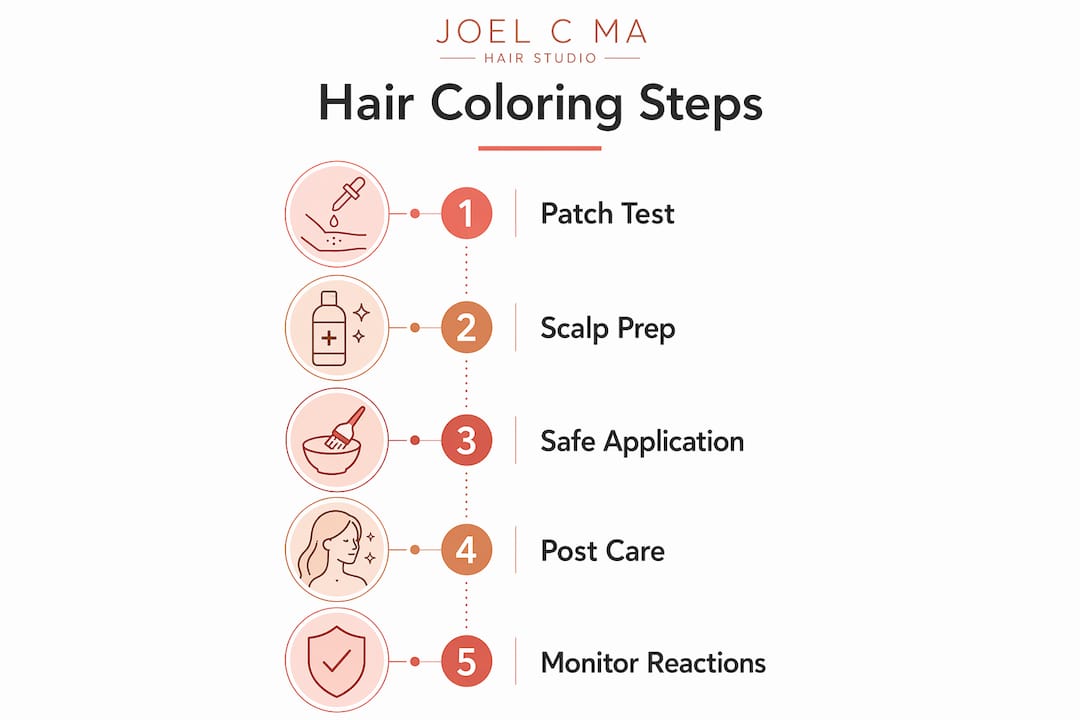
The patch test is the single most important hair dye safety tip, and it must be repeated before every coloring session, not just the first time you use a product. Allergic sensitization to hair dye chemicals, particularly para-phenylenediamine (PPD), can develop at any point. A product you used safely six months ago can trigger a severe reaction today.
Here is how to perform it correctly:
- Choose your test site. Apply a small amount of the mixed dye behind one ear or on the inner elbow. Both sites have thin, sensitive skin that mirrors scalp reactivity.
- Use the right amount. The test area should cover roughly 15 to 20mm, about the size of a small coin. More is not better here.
- Leave it undisturbed. Do not wash the area for the full 48-hour test window. Washing early invalidates the result.
- Watch for reactions. Redness, itching, swelling, or blistering at the test site means stop. Do not proceed with coloring.
- Clear result means proceed. No reaction after 48 hours indicates you can safely apply the dye to your hair.
The reason you repeat this before every session matters more than most people realize. Allergic sensitization worsens with each exposure. What starts as mild itching can escalate to anaphylaxis with repeated contact. Prior safe use is not a guarantee of future safety. Your immune system can build a response over months or years without any warning signs until the threshold is crossed.
People with a history of atopic dermatitis, eczema, or asthma face a higher baseline risk for contact allergies. If you fall into this group, patch testing is not optional. It is the minimum precaution. Consulting a dermatologist before your first color session is a smart move if you have any history of skin sensitivity.
Pro Tip: Mix the patch test dye using the exact developer ratio you plan to use for the full application. Testing with a different concentration gives you inaccurate results.
How to assess and prepare your scalp before coloring
Your scalp condition on the day you color is as important as the product you choose. Coloring over a compromised scalp barrier accelerates chemical absorption and dramatically increases the risk of irritation and adverse reactions.
Key conditions that raise your risk include:
- Psoriasis and seborrheic dermatitis. Both conditions disrupt the scalp’s protective barrier. Compromised scalp barriers significantly increase the likelihood of adverse reactions during coloring. Get the condition under control before any dye touches your scalp.
- Cuts, abrasions, or sunburn. Broken skin allows dye chemicals to penetrate faster and deeper. Even a small scratch from aggressive brushing can become a chemical entry point.
- Recent chemical treatments. Combining a color service with a relaxer, keratin treatment, or bleach session without adequate recovery time stresses the scalp and hair structure simultaneously.
The preparation step most people skip is also the simplest. Avoid washing your hair for three days before your color appointment. Your scalp’s natural sebum acts as a protective film between the skin and the dye chemicals. Stripping it away with a fresh shampoo removes that barrier right before you need it most.
If you have an active scalp condition, see a dermatologist before coloring. This is not overcaution. It is the difference between a controlled color session and a reaction that requires medical treatment. A dermatologist can also recommend prescription barrier creams that provide additional protection during application.

Pro Tip: If your scalp feels tight or flaky in the days before coloring, apply a light scalp oil like jojoba or argan the night before. It supplements your natural sebum without leaving heavy residue that interferes with color uptake.
Safe application practices that reduce chemical exposure
The way you apply hair dye matters as much as the product you choose. Hair dye chemicals can penetrate scalp skin and enter the body through inhalation of volatile organic compounds (VOCs) or absorption through irritated skin. Reducing exposure during application is a direct way to lower your cumulative chemical load.
Follow these application practices every time:
- Wear gloves throughout. Nitrile gloves offer better chemical resistance than the thin latex gloves often included in box dye kits. Skin contact with PPD and resorcinol during application is a primary sensitization route.
- Work in a ventilated space. Open windows, run a bathroom fan, or color outdoors when possible. VOC inhalation during mixing and application is a real exposure risk, not a theoretical one.
- Apply petroleum jelly along the hairline. Petroleum jelly on the hairline creates a physical barrier that prevents dye from staining and irritating the forehead, ears, and neck. Wipe it away after rinsing.
- Follow mixing ratios exactly. Deviating from the developer-to-color ratio specified in the instructions changes the chemical reaction. A higher developer concentration increases oxidative stress on the scalp and hair shaft.
- Check the expiration date. Expired hair dye increases the risk of scalp damage and unpredictable chemical reactions. Expiration dates on dye products typically fall between six and twelve months after manufacture, and nearly half of tested products lacked clear shelf life information on the label.
- Keep dye away from your eyes. The skin around the eyes is thinner and more permeable than scalp skin. If dye contacts your eyes, rinse immediately with water for at least fifteen minutes.
One nuance worth understanding: “natural” or “organic” labels on hair dye packaging are marketing terms, not safety certifications. As dermatologist Victoria Barbosa notes, plant-based dyes can still trigger allergic reactions and may contain harmful VOCs or heavy metals. Patch test every product regardless of how it is labeled.
Post-application care: what to do after you rinse
The steps you take in the 72 hours after coloring determine both how well the color sets and how well your scalp recovers. Rushing this phase is one of the most common mistakes in healthy hair coloring practices.
| Action | Timing | Why it matters |
|---|---|---|
| Rinse dye thoroughly | Immediately after processing time | Removes residual chemicals that continue reacting on the scalp |
| Wait before shampooing | 24 to 72 hours post-color | Allows pigment molecules to fully oxidize and bond to the hair shaft |
| Use a color-safe shampoo | First wash onward | Sulfate-free formulas preserve the color and reduce scalp stripping |
| Avoid heat styling | First 48 hours | Heat opens the cuticle and accelerates color fade and moisture loss |
| Monitor for delayed reactions | 24 to 96 hours post-application | Allergic reactions can appear up to four days after contact |
The 24 to 72 hour window before your first shampoo is not just about color longevity. It is also a recovery period for your scalp. The oxidative process continues after you rinse, and washing too early disrupts it. Choosing the right shampoo for that first wash matters too. The best color-safe conditioners are formulated to maintain the hair’s moisture balance without stripping the dye molecules that have bonded to the cortex.
Watch for delayed allergic reactions in the days after coloring. Symptoms include persistent itching, swelling of the scalp or face, hives, or difficulty breathing. If itching or burning occurs during coloring, rinse immediately and seek dermatologist advice for severe reactions. A mild reaction left untreated can become a severe one with the next exposure.
Pro Tip: Rinse with cool water rather than hot during your first post-color wash. Hot water swells the hair cuticle and pushes color molecules out faster, shortening the life of your color significantly.
Key takeaways
Safe hair coloring requires patch testing before every session, a healthy scalp barrier, protective application practices, and careful post-color care to prevent allergic reactions and long-term chemical harm.
| Point | Details |
|---|---|
| Patch test every time | Perform a 48-hour patch test before each session, even with familiar products, to catch new sensitivities. |
| Protect your scalp barrier | Avoid washing hair three days before coloring so natural oils shield the scalp from chemical irritation. |
| Minimize chemical exposure | Wear nitrile gloves, ventilate the space, and apply petroleum jelly along the hairline during every application. |
| Wait before shampooing | Hold off on washing for 24 to 72 hours post-color to allow pigment to fully bond and the scalp to recover. |
| Watch for delayed reactions | Monitor your scalp for up to four days after coloring and stop use immediately if any reaction develops. |
The precaution most people treat as optional
After more than two decades working in professional hair color, the pattern I see most consistently is this: people treat the patch test as a formality for first-time users and skip it once they have a “trusted” product. That thinking is exactly backward. The risk of sensitization increases with cumulative exposure, not decreases. The client who has been using the same box dye for five years is more likely to develop a reaction than someone trying it for the first time.
What I have also learned is that long-term cumulative exposure to hair dye chemicals is the real concern, not the single application. This is why I recommend that regular color clients consider semi-permanent or demi-permanent formulas for maintenance sessions between major color changes. They deliver significantly less oxidative stress on the scalp over time.
The other thing I push back on is the idea that “going natural” with your dye automatically makes it safer. It does not. I have seen reactions to henna and plant-based color that were as severe as anything caused by a conventional permanent dye. Read the ingredient list, not the marketing copy on the front of the box.
Approach coloring as a preparation ritual, not just a styling decision. The thirty minutes you invest in a patch test, a scalp check, and proper setup is the difference between a great result and a trip to urgent care. For anyone who wants expert guidance on color choices that work with their specific scalp and hair type, a consultation with a professional colorist at a salon like Joelcma is worth far more than any amount of online research.
— Juiced
Expert color care from Joelcma

Joelcma’s team at Joel C Ma Hair Studio in La Jolla brings over 25 years of professional color expertise to every client consultation. If you are planning a color change and want guidance on the safest approach for your hair type and scalp condition, their colorists provide personalized recommendations that go well beyond what any box dye instruction sheet covers. For your post-color routine, start with the right products. The best salon shampoos for colored hair curated by Joelcma’s experts are formulated to protect your investment and keep your scalp healthy between sessions. For answers to specific color questions, the hair coloring expert FAQ covers the most common concerns with professional-level detail.
FAQ
How long should a hair dye patch test take?
A patch test requires a full 48 hours to produce accurate results. Apply the mixed dye to the inner elbow or behind the ear, leave it unwashed, and check for redness, itching, or swelling at the 48-hour mark before proceeding.
Can you color hair with psoriasis or seborrheic dermatitis?
You can color hair with these conditions, but only when the condition is actively controlled and the scalp skin is intact. Coloring over inflamed or broken skin significantly increases chemical absorption and the risk of a severe reaction.
Why does hair dye cause allergic reactions?
Most allergic reactions to hair dye are triggered by PPD (para-phenylenediamine), a chemical in permanent and semi-permanent dyes. Sensitization builds with repeated exposure, meaning reactions can appear after years of safe use with no prior warning.
Is it safe to color hair at home without professional help?
Home coloring is safe when you follow all precautions: patch test 48 hours in advance, wear gloves, ventilate the space, follow mixing instructions exactly, and avoid coloring over irritated or broken skin. Skipping any of these steps increases your risk.
How soon after coloring can you wash your hair?
Wait 24 to 72 hours before your first shampoo after coloring. This window allows the pigment to fully oxidize and bond to the hair shaft, extending color vibrancy and giving your scalp time to recover from the chemical process.