
Every Kind of Haircut for Men and Women: 2026 Guide

What are the most popular kinds of haircuts right now?
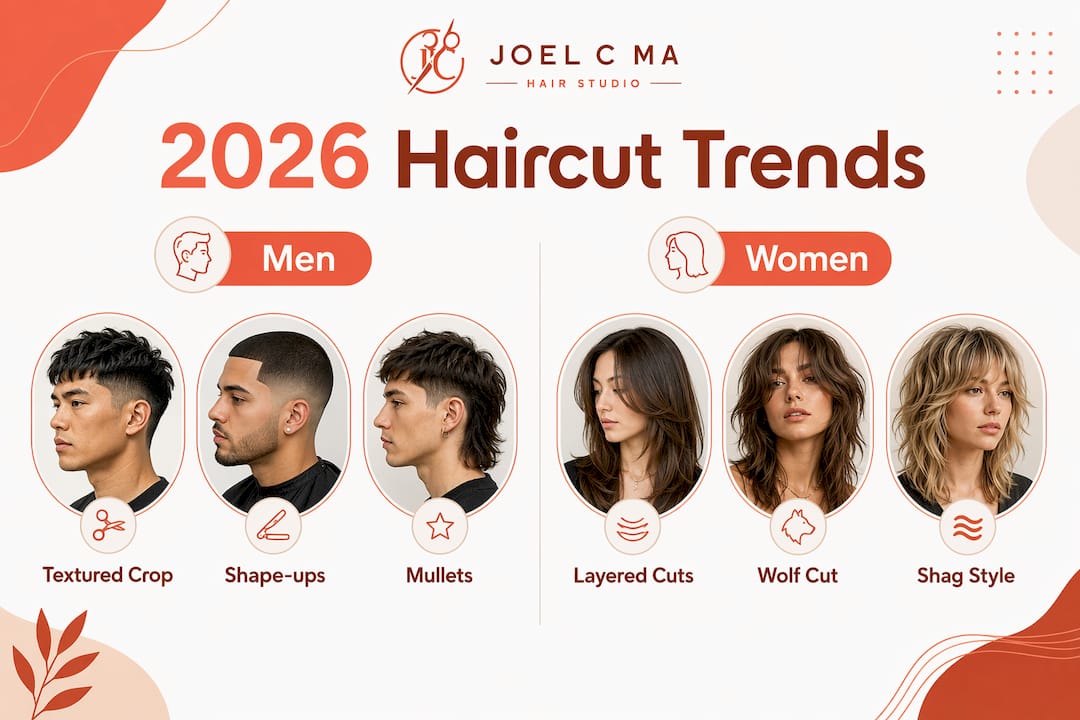
The most requested haircuts in 2026 break down cleanly by gender and length. For men, the textured crop leads the pack, followed by fades, crew cuts, and tapers. For women, the wolf cut, textured bob, curtain bangs, lob, and butterfly cut dominate salon request lists. The through line across all of them: styles that work with natural hair texture rather than fighting it.
Hair length categories shape the conversation too. Short styles like buzz cuts and pixies require the least upkeep. Medium styles, from lobs to textured crops, offer the widest range of versatility. Long styles, including shags and layered cuts, reward patience and a good product routine.
A few techniques drive most of what you see trending right now:
- Layering removes weight and adds movement without reducing length
- Fading creates a gradient from skin to longer hair, most common in men’s cuts
- Blunt cutting produces a clean, heavy edge with no tapering
- Point cutting softens ends and adds texture
- Texturizing thins dense sections to reduce bulk and encourage natural movement
Men’s haircut styles that are actually trending in 2026
Men’s cuts in 2026 lean toward low-maintenance shapes that still look intentional. The textured crop remains the most requested style in US salons, defined by short sides, a choppy top, and a forward-pushed fringe. A crew cut with a skin fade takes roughly 30 seconds to style each morning, which explains a lot of its staying power.
The fade family
Fades are the defining structural element of modern men’s haircuts. The gradient runs from very short or skin-level at the bottom to longer hair higher up. Three main variants:
- Low fade: starts just above the ear, subtle and professional
- Mid fade: begins at temple level, the most popular choice in US barbershops right now
- High fade: starts at or above the temples, maximum contrast, bold look
Clients often confuse fades with tapers. A fade vs. taper distinction matters when you are sitting in the chair: a fade is a long, gradual gradient across the side of the head, while a taper is a short, concentrated transition just above the neckline and around the ears. Asking for the wrong one gets you a very different result.
Classic and structured cuts
- Crew cut: short all around, slightly longer on top, clean taper at the sides. Works on nearly every face shape and grows out gracefully.
- Buzz cut: uniform length across the entire head, cut with clippers. Zero styling required.
- Pompadour: hair swept upward and back from the forehead, held with product. Works best on oval and square face shapes.
- Undercut: longer hair on top, clipped short or shaved on the sides and back. Creates strong contrast.
- Two-block cut: voluminous crown with cropped sides, popularized by K-pop culture and now mainstream in the US.
Shape-ups and line-ups
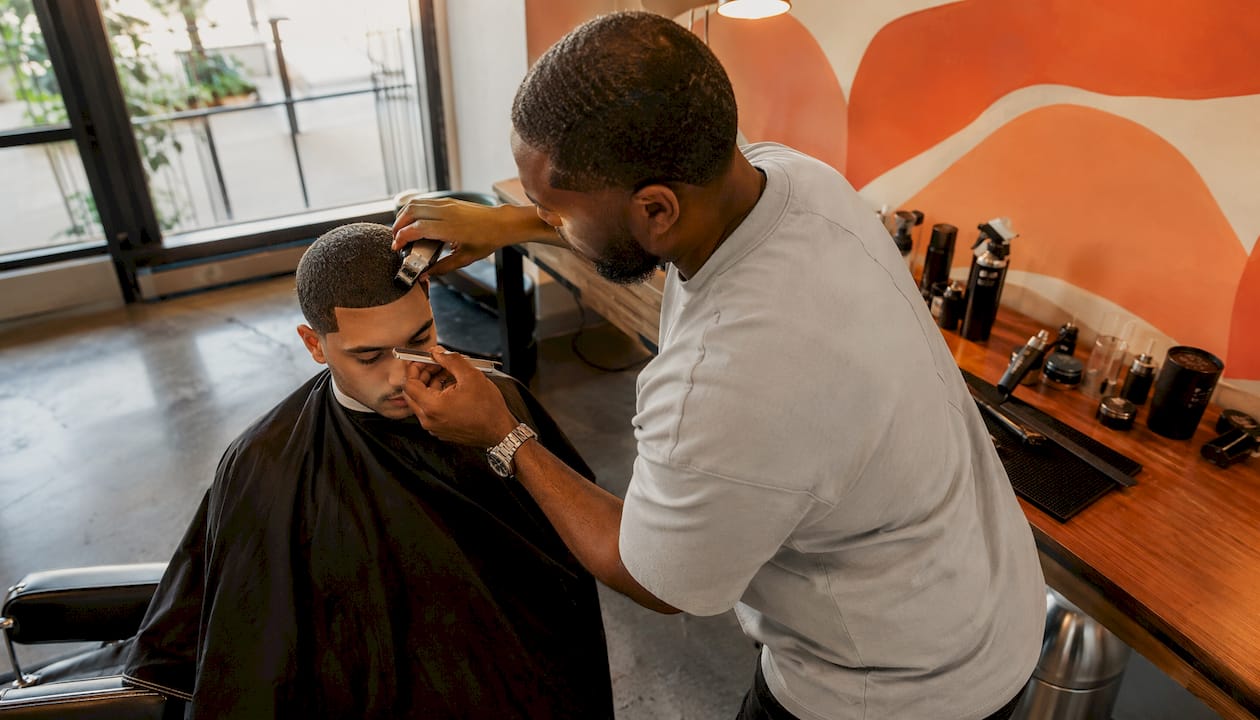
The shape-up, also called a line-up or edge-up, redefines the hairline at the forehead, temples, and sideburns using a straight razor or precision trimmer. It does not change the cut itself but sharpens the entire look. Most barbers recommend a shape-up regularly to keep the lines crisp.
Mullet and longer men’s styles
The mullet, short in front and long in the back, has cycled back into mainstream US barbershops since 2022 and holds its ground in 2026, especially in textured and curly variations. For men growing hair longer, the key question is maintenance frequency. Fades and shape-ups look best when refreshed regularly. Crew cuts and longer styles can go several weeks without losing their shape.
How face shape affects men’s cut choices
- Oval face: most cuts work; fades and textured crops look especially clean
- Round face: high fades and pompadours add height, visually lengthening the face
- Square face: tapers and crew cuts complement strong jawlines without competing with them
- Oblong face: avoid adding height; side-parted classics and low fades balance proportions
Pro Tip: Before your appointment, prepare for your haircut by pulling reference photos of the exact fade height and top length you want. “Short on the sides” means something different to every barber.
Women’s haircut styles leading the trend cycle
Women’s haircuts in 2026 prioritize texture, movement, and styles that look good on second-day hair. The wolf cut sits at the top of the request list across the US, followed closely by the textured bob, butterfly cut, and lob.
Short women’s cuts
- Pixie cut: cropped close on the sides and back, with slightly more length on top. Switching to a pixie can revitalize hair health by removing damaged ends, and stylists describe the transformation as genuinely refreshing for both hair condition and personal confidence.
- Blunt bob: cut straight across at jaw level with no layering. Clean, graphic, and perennially requested. Works best on straight to slightly wavy hair.
- Textured bob: same length as a blunt bob but with point cutting or razor work to add movement. Better for wavy and fine hair types.
Medium-length cuts
- Lob (long bob): falls anywhere from chin to collarbone. Arguably the most versatile women’s cut available, working across straight, wavy, and curly hair with minimal adjustment.
- Curtain bangs: a fringe parted in the center and swept to either side, framing the face without covering the forehead fully. Pairs with almost any length.
- Shag: a choppy, layered cut with fullness at the crown and fringe around the edges. Particularly flattering on wavy and curly hair because the layers work with natural texture rather than against it.
Longer cuts and statement styles
- Wolf cut: a hybrid of the shag and the mullet, shorter at the front and longer in the back, with heavy layering throughout. Worn by Billie Eilish, Miley Cyrus, and Camila Cabello, it crossed from celebrity to mainstream US salons around 2022 and has not slowed down.
- Butterfly cut: face-framing layers that start short around the face and gradually lengthen toward the back, creating a wing-like silhouette when the hair moves.
- Layered long hair: different sections cut at different lengths to create depth and reduce bulk. The go-to for anyone with thick hair who wants movement without losing length.
How hair type shapes the choice
Straight hair holds blunt cuts and bobs cleanly. Wavy hair benefits from layering, which lets the wave pattern express itself without looking shapeless. Curly hair needs cuts that account for shrinkage, so stylists typically cut it dry to see the curl’s true length. Coily hair responds well to the Deva cut technique, which shapes each curl individually.
Face shape and women’s cuts
- Round face: lobs, long layers, and side-swept bangs add length
- Square face: soft layers and curtain bangs soften angular jawlines
- Heart face: chin-length bobs and lobs balance a wider forehead
- Oval face: the most flexible shape; nearly any cut works
For women looking to boost volume with their cut, layered styles and the wolf cut consistently deliver the most lift without requiring heat tools every morning.

How to maintain and style different haircut types
The right cut should make your morning routine shorter, not longer. The best haircuts work with your natural growth pattern, reducing product dependency and heat damage over time.
Maintenance schedules by cut type
- Fades and shape-ups: every 2–3 weeks to keep lines sharp
- Textured crops and bobs: every 4–6 weeks
- Bangs and fringes: every 3–4 weeks to maintain the intended length
- Lobs and longer cuts: every 8–12 weeks for a trim to prevent split ends
- Pixie cuts: every 4–6 weeks, since even small growth changes the silhouette noticeably
Products matched to cut and texture
- Fine, straight hair: lightweight volumizing mousse or spray; avoid heavy creams that flatten
- Wavy hair: curl-enhancing cream or sea salt spray applied to damp hair
- Curly and coily hair: leave-in conditioner plus a defining gel or custard; diffuse rather than blow-dry straight
- Short men’s cuts: matte clay or paste for texture and hold without shine; pomade for slicker, more polished looks
Low-maintenance options worth knowing
The shag suits wavy and curly hair particularly well because the layers follow the natural texture, meaning it looks intentional even without styling. The blunt bob is the low-maintenance pick for straighter hair, since the clean line reads as polished with just a quick blow-dry. For men, the crew cut with a skin fade requires almost no daily effort once the shape is set.
Pro Tip: Ask your stylist to show you exactly how to style your new cut before you leave the salon. Watching the technique once is worth more than any tutorial video, because your stylist knows your specific texture and growth pattern.
Expert insights on choosing the haircut that actually suits you
Choosing a cut that fits your life starts before you sit in the chair. Bringing reference photos to your consultation closes the gap between what you picture and what your stylist hears. Words like “fresh” or “modern” mean different things to different people. A photo removes the ambiguity entirely.
A few factors stylists at Joelcma consistently weigh during consultations:
- Natural growth pattern: cowlicks, whorls, and hairline shape all affect how a cut falls and behaves daily
- Hair density and texture: a cut that looks great on fine straight hair may not translate to thick coily hair without significant adjustment
- Lifestyle and styling time: a high-maintenance cut on someone with a five-minute morning routine will always look undone
- Face shape: as covered above, proportions matter, and a skilled stylist will flag when a requested cut works against your natural structure
- Hair health: damaged, over-processed hair sometimes needs a significant length change before a new style can be executed properly
Life transitions, whether a new job, a move, or a personal shift, often prompt haircut changes that also benefit hair condition. Removing damaged ends through a major cut refresh is not just cosmetic; it genuinely improves the hair’s texture and manageability going forward.
Joelcma’s stylists also use detailed records of each client’s cut, including guard sizes, length preferences, and product notes, to deliver consistent results across appointments. That kind of documentation, sometimes called clip notes, means you never have to re-explain your entire history every time you come in.
For a deeper look at how to choose a haircut style that matches your texture and growth pattern, Joelcma’s team walks through the full decision process.
How haircuts carry cultural and historical weight
Hair has never been just about aesthetics. Across cultures and centuries, the way people cut their hair has signaled identity, status, rebellion, and belonging.
The pompadour takes its name from Madame de Pompadour, the mistress of King Louis XV of France in the 18th century. The style moved from aristocratic French courts to American rockabilly culture in the 1950s, carried by Elvis Presley, and has cycled through fashion ever since. The crew cut became synonymous with American military identity in the 20th century, adopted by the armed forces for its practicality and later by civilians as a symbol of clean-cut respectability.
The Afro carries a different kind of cultural weight. It emerged as a powerful symbol of Black pride and political identity during the civil rights and Black Power movements of the late 1960s and 1970s in the United States. Wearing natural African hair unstraightened and uncombed was a deliberate act of cultural affirmation. The resurgence of natural hair styles among Black Americans in the 2010s echoed that same assertion of identity, this time in the context of the natural hair movement.
The mullet has its own layered history. Described as “business in front, party in the back,” it peaked in American popular culture in the 1980s, crossed into working-class and rural iconography, and became a punchline by the 1990s. Its current revival is partly ironic, partly genuine, and entirely a product of Gen Z’s appetite for reclaiming aesthetically charged styles from previous decades.
The two-block cut, now popular across the US, originated in South Korean celebrity culture and spread globally through K-pop fandom. Its mainstream adoption in American salons is a direct result of how quickly style now travels across borders through social media.
Braids, cornrows, and locs carry deep roots in African and African American traditions, functioning as cultural markers, protective styles, and artistic expression simultaneously. The queue, a long braided ponytail worn by Manchu men during China’s Qing dynasty, was a state-mandated style with serious political implications for those who refused it.
Even the pixie cut has a cultural story. When Audrey Hepburn wore it in the early 1950s and Twiggy popularized it in the 1960s, it was read as a radical departure from femininity norms. Today it reads as confident and self-possessed, but the history of what it once meant to cut a woman’s hair that short is still part of why the style carries such charge.
Understanding that context does not change how a cut looks on you, but it does explain why certain styles feel loaded, why some clients feel nervous about a major change, and why a haircut can mean something beyond the shape of the hair itself.
Ready to find your next cut?

Whether you are after a creative men’s haircut for 2026 or a women’s style that works with your natural texture, Joelcma’s team in La Jolla brings over 25 years of expertise to every consultation. The studio’s approach starts with a real conversation about your hair’s behavior, your lifestyle, and what you actually want to walk out with.
For professional women looking for polished, manageable styles, Joelcma’s expert tips for professional women cover the cuts and techniques that hold up through a full workday. And if your new cut comes with a color refresh, the salon shampoo guide for colored hair walks through exactly what to use to protect your investment.
Book a consultation at joelcma.com and bring your reference photos.
Key Takeaways
The most flattering haircut is the one designed around your natural texture, growth pattern, and lifestyle, not just the style trending on social media.
| Point | Details |
|---|---|
| Top men’s styles in 2026 | Textured crop, fades (low, mid, high), crew cut, and tapers lead US salon requests. |
| Top women’s styles in 2026 | Wolf cut, textured bob, lob, curtain bangs, and butterfly cut dominate current trend lists. |
| Maintenance frequency | Bangs need trims every 3–4 weeks; fades every 2–3 weeks; lobs and longer cuts every 8–12 weeks. |
| Consultation matters | Bringing reference photos closes the gap between what you picture and what your stylist executes. |
| Texture-first approach | Cuts designed around natural hair movement reduce daily styling time and heat damage over time. |