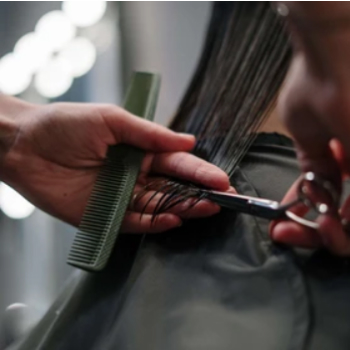

Home vs Salon Haircuts for Men: Which Wins?

TL;DR:
- Men often choose between home and salon haircuts based on cost, style complexity, and convenience. Home cuts are cost-effective for simple styles and frequency, while salons offer expert service for complex, high-maintenance styles. The best choice depends on individual priorities, hair type, and desired results, with hybrid approaches also being effective.
Every man faces the same recurring decision: grab the clippers yourself or book an appointment. The home vs salon haircuts men debate comes down to more than just money. You are weighing your time, your skill level, the complexity of the style you want, and honestly, how much the experience itself matters to you. This article breaks down each option with real numbers, practical trade-offs, and specific situations where one clearly beats the other, so you can stop guessing and start choosing with confidence.
Table of Contents
- Key takeaways
- 1. Home vs salon haircuts for men: the six factors that matter
- 2. Home haircuts for men: benefits, challenges, and best practices
- 3. Salon haircuts for men: advantages and what to expect
- 4. Head-to-head comparison of home vs salon haircuts
- 5. Situational advice: choosing based on your lifestyle and hair type
- My honest take after watching men make this choice for years
- See what expert hands can do for your hair
- FAQ
Key takeaways
| Point | Details |
|---|---|
| Cost gap is significant | Salon cuts cost $500 to $800 per year; a quality clipper set pays for itself in under three months. |
| Style complexity drives the choice | Simple buzz and crew cuts suit home cutting well; fades, tapers, and textured finishes favor a professional. |
| Learning curve is short | Most men achieve clean home cuts within three attempts using the right technique and tools. |
| Salons offer more than cuts | Color, texture treatments, and styling consultations are services no clipper set can replicate. |
| Hybrid approach works best | Home cuts maintain length between visits while occasional salon trips preserve precision and style integrity. |
1. Home vs salon haircuts for men: the six factors that matter
Before picking a side, you need to know what you are actually comparing. The decision is not one-size-fits-all, and the right answer changes based on your priorities.
- Cost and long-term savings. Men’s haircuts average $30 to $50 every three to four weeks, adding up to $500 to $800 annually. A quality clipper set runs $50 to $150 and pays for itself within two to three months.
- Skill and style complexity. A simple buzz cut is learnable. A skin fade with a sharp lineup is not. Know what you want before you decide where to get it.
- Convenience and scheduling. Home cuts happen at midnight if you want. Salon appointments require planning, travel, and wait time.
- Consistency and outcome quality. Professionals produce repeatable results. Home cuts improve with practice but rarely match a trained hand on technical styles.
- Experience and atmosphere. Some men treat their barbershop visit as a ritual. Others just want the job done.
- Maintenance frequency. Buzz and crew cuts need a trim every two to three weeks, while textured crops can stretch to four to six weeks. High-frequency styles make home cutting far more cost-effective over time.
Pro Tip: Map your maintenance schedule before you decide. If you cut your hair every two weeks, the math almost always favors buying a good clipper set. If you go every six weeks, the cost difference shrinks considerably.
2. Home haircuts for men: benefits, challenges, and best practices
The financial case for cutting your own hair is strong. The annual savings of $500 to $800 alone make home haircuts worth considering for most men on any style that does not demand barbershop-level precision.
What you gain
The obvious win is money. The less obvious win is convenience. No booking apps, no waiting around, no awkward small talk if you are not in the mood. You cut when it works for you, whether that is Sunday morning or the night before a big meeting.
The learning curve is also shorter than most men expect. Most beginners achieve clean results within three attempts using a structured approach. The barrier is mostly mental. The technique itself, particularly using a rocking clipper motion and adjusting the lever for blending, becomes natural quickly with practice.
What you sacrifice
Home cuts have real limits. Fades, tapers, and sharp neckline finishes require spatial awareness and hand angles that are genuinely hard to execute on yourself. You also cannot see the back of your head without a dual-mirror setup, which adds friction. Mistakes on yourself are more stressful than mistakes at a salon, where someone else is responsible.
Limited styling options are another honest downside. You can maintain length and shape, but you cannot easily do the layered, textured, or blended work that makes a cut look designed rather than maintained.
Best tools for home cutting
You do not need a professional kit to get good results. A reliable setup includes:
- A quality corded or cordless clipper with multiple guard sizes (Wahl and Andis are the go-to brands)
- A detail trimmer for necklines and edges
- A dual-mirror setup or wall-mounted mirror
- Clipper oil and a cleaning brush for maintenance
- A neck duster or styling cape
Pro Tip: Start with a longer guard than you think you need. You can always go shorter. Going shorter by accident is a much worse problem.
3. Salon haircuts for men: advantages and what to expect
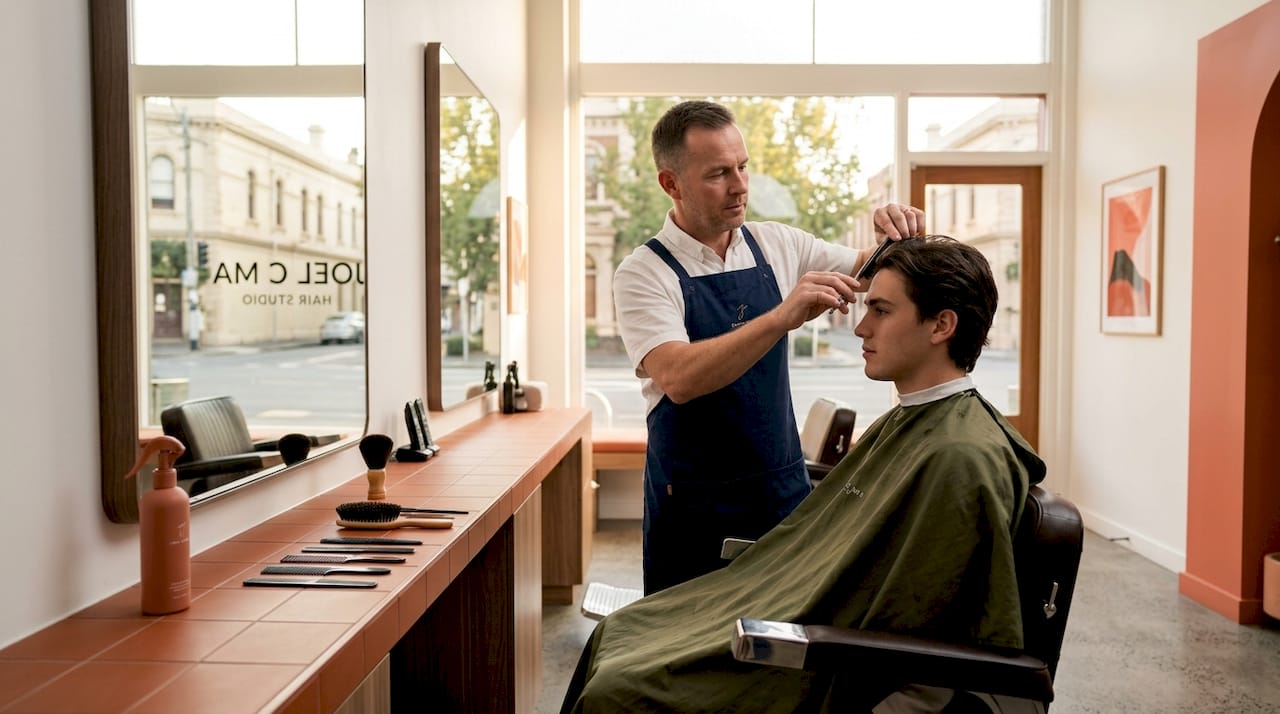
Professional haircuts deliver something home setups fundamentally cannot: trained eyes, skilled hands, and a result that looks intentional from every angle.
What professionals bring to the cut
Barbers specialize in clipper work, fades, tapers, and beard maintenance, while salon stylists focus on scissor-based cutting, color, chemical treatments, and long hair. That distinction matters when you are choosing where to go. A skin fade needs a barber. Balayage, color, or a textured scissor cut that requires heat styling needs a salon.
Barbers’ training covers licensed practice in straight razor shaves, beard lineups, and clipper work built specifically around men’s hair contours and growth patterns. That depth of specialization shows in the finished product.
The services that justify the cost
Beyond the cut itself, professional visits offer:
- Scalp and hair health assessments
- Styling product recommendations tailored to your hair type
- Color, highlights, and chemical treatments
- Beard shaping, trimming, and hot towel treatments
- Consultations that factor in face shape, lifestyle, and maintenance willingness
For complex styles or big changes, bringing two to three reference photos to your appointment is the single most effective way to get what you actually want. It removes ambiguity and gives your stylist something concrete to work from.
The social and experiential side
About 48% of men show high loyalty to their barber, and that loyalty is not just about the cut. Barbershops carry a social atmosphere that most salons do not replicate, with a sense of community and ritual that many men genuinely value. If the experience matters to you, that is a real part of the value equation.
4. Head-to-head comparison of home vs salon haircuts
Here is how the two options stack up across the factors that drive most men’s decisions.
| Factor | Home haircut | Salon or barbershop |
|---|---|---|
| Annual cost | $50 to $150 (equipment) | $500 to $800 per year |
| Style complexity | Best for simple, clipper-friendly styles | Handles all styles including fades, color, and texture |
| Skill requirement | Moderate. Learnable within a few sessions | None required from you |
| Scheduling | Fully flexible, no appointment needed | Requires booking and travel time |
| Consistency | Improves with practice but varies | High consistency from a trusted professional |
| Experience and atmosphere | Minimal | Social, ritualistic, especially at barbershops |
| Best for hair type | Straight, low-maintenance, shorter styles | All types, especially curly, thick, or textured hair |
The barbershop vs salon experience also differs significantly from each other, not just from home cutting. Choosing between a barber and a stylist involves its own set of trade-offs worth understanding before you book.
5. Situational advice: choosing based on your lifestyle and hair type
The comparison table is useful. But the right answer for you depends on specifics.
- You want a buzz cut or crew cut. Go home. These styles are clipper-friendly, forgiving of minor errors, and need frequent maintenance. The ROI on your own clippers is obvious here.
- You want a fade or skin taper. Go professional. The barbershop skill set for fades and tapers involves precision that takes years to develop. Attempting it at home often ends in a patchy, uneven result.
- Your schedule is unpredictable. Home cutting wins on pure logistics. No cancellations, no rescheduling fees, no fitting appointments around work.
- You have curly or thick hair. Salon or barbershop. Curly and textured hair requires understanding of how curl patterns and density interact, which is hard to self-assess and harder to cut well without experience.
- You want to add color or try a new style direction. Salon every time. Salons specialize in color, chemical treatments, and heat styling that require professional products and technique.
- You are budget-constrained but care about appearance. Consider a hybrid model. Use home cuts to maintain shape and length between sessions. Visit a men’s grooming routine that includes a professional visit every six to eight weeks to reset precision on fades and lines.
- You are building a new look or recovering from a bad haircut. See a professional. This is exactly when trained eyes and a skilled consultation matter most. A stylist can assess what you have to work with and map a realistic path to where you want to go.
Pro Tip: Even if you cut your hair at home 90% of the time, one annual visit to a good stylist for a shape reset is worth the investment. It gives you a clean template to maintain at home.
Explore popular men’s styles before your next appointment or DIY session so you know exactly what you are working toward.
My honest take after watching men make this choice for years
I have seen men fall into two camps and both get it wrong in the same way. The first group goes full DIY and gradually accepts worse and worse results because they got used to it. The second group books salon appointments religiously for a buzz cut that takes six minutes and costs $45. Neither extreme makes sense.
What I have found actually works is intention. Men who think about what they want from their hair and match the method to that goal get the best results. If your hair is your thing, invest in a stylist relationship. If your hair is just something that needs to not look bad, invest in a decent clipper set and learn the basics.
The misconception I hear most is that home cuts always look worse. They do not, given the right style and the right tools. The other misconception is that salons are only for women or for special occasions. A good male stylist or barber can change how you carry yourself in a way that no clipper set will.
My honest advice: start by knowing what you actually want. Then choose the method that can deliver it, not the one that costs less or feels more convenient. And if you have never had a real consultation with a skilled stylist, book one. Not to commit to anything. Just to understand what your hair can actually do.
— Joelcma
See what expert hands can do for your hair
If you have been settling for DIY results on a style that deserves professional attention, or if you are just curious what a skilled consultation would reveal about your hair, Joelcma is worth your time.

At Joel C Ma Hair Studio in La Jolla, California, the team has over 25 years of experience delivering precision haircuts for men that account for your face shape, hair texture, and lifestyle. Whether you want a sharp fade, a textured scissor cut, or a full style refresh with color, every appointment starts with a real conversation about what works for you. For men who want a look that feels personalized rather than generic, this is the kind of studio that makes that possible. You can also explore customized hair styling options to understand what a tailored approach looks like before you book.
FAQ
How much can I save cutting my hair at home?
Annual savings run $500 to $800 compared to regular salon visits, with a quality clipper set paying for itself within two to three months.
How hard is it to cut your own hair as a man?
The learning curve is short. Most men get clean results within three attempts, especially on simple styles like buzz cuts and crew cuts.
When should men always go to a professional?
Go professional for fades, tapers, beard lineups, color work, and any style involving curly or thick hair that requires clipper precision and technical blending.
What is the difference between a barber and a salon stylist?
Barbers specialize in clipper work, fades, and beard maintenance, while salon stylists handle color, chemical treatments, long hair, and scissor-based cutting.
How often should men get a professional haircut?
It depends on the style. Buzz and crew cuts need attention every two to three weeks, while textured crops can go four to six weeks between cuts.