
Types of Hair Color Services: Your 2026 Style Guide
TL;DR:
- Choosing the right hair color service depends on your hair type, desired maintenance, and lifestyle to ensure lasting, healthy results. Low-maintenance options like balayage and French blending extend intervals between salon visits and minimize damage, while vivid colors require frequent touch-ups and higher upkeep. Consulting a professional beforehand helps tailor a color plan that suits your goals, hair health, and budget for optimal, long-lasting results.
Choosing between the many types of hair color services can feel overwhelming when you are standing in front of a salon menu with a dozen techniques staring back at you. Balayage or foil highlights? Root touch-up or full color? Each service delivers a genuinely different result, and picking the wrong one means months of maintenance you did not plan for or a look that does not suit your lifestyle. This guide breaks down every major option, compares them side by side, and gives you the clarity to walk into any salon knowing exactly what you want.
Table of Contents
- Key takeaways
- What to consider before choosing a hair color service
- Popular types of hair color services explained
- Comparing hair color services: maintenance, cost, and impact
- How to choose the best hair color service for your lifestyle
- My perspective on hair color services in 2026
- Experience expert hair color at Joel C Ma Hair Studio
- FAQ
Key takeaways
| Point | Details |
|---|---|
| Know your maintenance tolerance | Low-maintenance techniques like balayage extend touch-up intervals to 3 to 5 months, while foils need attention every 6 to 8 weeks. |
| Hair health matters for technique choice | Balayage is gentler than full-head bleaching, making it a smarter pick for fragile or previously processed hair. |
| French blending softens gray naturally | This technique blends dimensional highlights and lowlights at roots to diffuse gray without full coverage. |
| Personalized color mapping is trending | 2026 color placement follows your haircut and texture for a bespoke finish, not a one-size-fits-all formula. |
| Budget varies widely by technique | Complex services like balayage cost more upfront but require fewer visits, while global color is cheaper per appointment but more frequent. |
What to consider before choosing a hair color service
Before you commit to any particular technique, a few practical factors will determine which professional hair dye services will actually work for your hair and your life.
- Hair type and texture. Coarse or curly hair absorbs color differently than fine, straight hair. The right technique accounts for how your texture behaves with lightener or deposit-only color.
- Maintenance level. Ask yourself honestly how often you plan to return to the salon. Some services show regrowth within weeks; others grow out gracefully for months.
- Desired outcome. Are you after a subtle shift in dimension, a dramatic color change, or gray blending? Your goal narrows the list fast.
- Hair health. If your hair has been bleached, heat-styled heavily, or chemically processed, gentler deposit-only or balayage techniques reduce the risk of breakage.
- Lifestyle factors. Swimmers, frequent outdoor workers, or people who style their hair daily need color choices that hold up to those conditions.
- Salon visit frequency and cost. Complex techniques cost more upfront but can save money over a year when they require fewer appointments. Global color is cheaper per session but needs more frequent attention.
Pro Tip: Book a consultation before committing to any service. A skilled colorist will assess your hair history, texture, and goals to create a color map specific to you, which means fewer corrections and better long-term results.
Thinking through these points before your appointment will help you have a much more productive conversation with your stylist. Learning how to choose a hair color for your specific features is a smart first step before stepping into the salon chair.
Popular types of hair color services explained
Here is where the different hair coloring options actually separate themselves. Each technique has a distinct method, look, and maintenance profile.
-
Single-process (global color). One formula is applied from root to tip for a uniform tone. It is the most straightforward and affordable service, ideal for covering gray fully or making a significant base color change. Regrowth lines are visible, and appointments are typically needed every four to six weeks.
-
Balayage. A colorist freehand paints lightener onto the surface of sections, leaving the root darker and gradually lightening toward the ends. The result is a sun-kissed, natural-looking gradient that grows out without harsh lines. Balayage is also less damaging than full-head bleaching because it avoids saturating every strand with lightener.
-
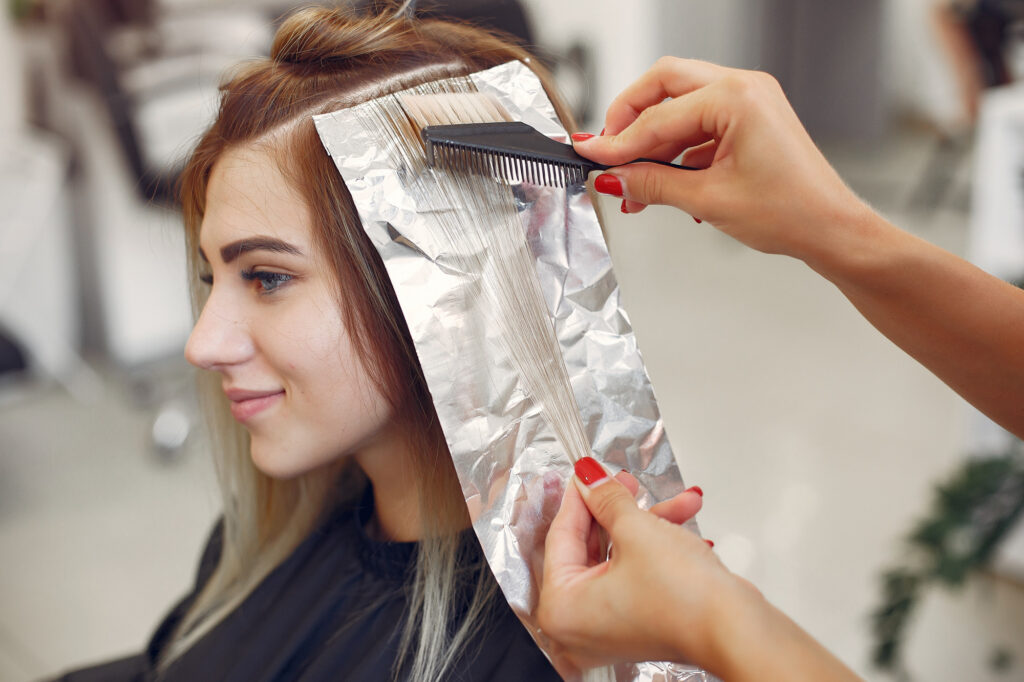
Foil highlights. Sections of hair are isolated in foils for precise, controlled lightening. This creates high-contrast brightness and works well for clients who want a more defined, dramatic lift. Touch-ups are typically needed every six to eight weeks as the regrowth line becomes apparent.
-
Lowlights. Darker tones applied in foils to selected sections add depth and dimension without any bleaching. Lowlights are excellent for creating fullness, softening an overly light result, or gently blending gray into naturally dark hair.
-
Babylights and microlights. These are ultra-fine highlights placed in very small sections, mimicking the natural variation children have in their hair. The effect is subtle and luminous rather than strongly contrasting. They work especially well on lighter base colors.
-
Root touch-ups and root melting. Root touch-ups refresh the base color at the scalp to eliminate visible regrowth. Root melting is a softer approach where the new color at the root is blended gradually into the mid-lengths, creating a shadow effect that reduces the abruptness of any line.
-
French blending. This is a specialized low-maintenance technique that places dimensional highlights and lowlights specifically around the root area to diffuse the contrast between gray and your natural color. It is designed for clients who want to soften gray without committing to full coverage and without frequent touch-ups. For more detail on this approach, Joelcma’s guide on grey blending techniques covers it thoroughly.
-
Vivid and creative color. This category covers fashion colors: pastels, jewel tones, split dye, and color melting across multiple bold shades. Results are striking but require significant pre-lightening and more intensive maintenance. Fading is a reality with vivid colors, and at-home care is critical to longevity.
The range of popular techniques now extends well beyond classic all-over color, giving clients far more control over both their look and their upkeep schedule. Exploring signature coloring techniques can help you get a clearer picture of how these services translate into real results.
Comparing hair color services: maintenance, cost, and impact
Seeing these best hair color types side by side makes the trade-offs immediately obvious.
| Service | Touch-up frequency | Damage level | Relative cost | Regrowth visibility |
|---|---|---|---|---|
| Global (single-process) | Every 4 to 6 weeks | Low to moderate | Low per visit | High, clear line |
| Foil highlights | Every 6 to 8 weeks | Moderate | Moderate | Moderate |
| Balayage | Every 3 to 5 months | Lower than foils | Higher upfront | Very low, blended |
| Lowlights | Every 3 to 4 months | Low | Moderate | Low |
| French blending | Every 3 to 5 months | Low | Moderate to high | Very low |
| Babylights | Every 8 to 12 weeks | Moderate | Moderate to high | Low |
| Vivid or creative color | Every 4 to 6 weeks | High (pre-lightening needed) | High | Moderate to high |
The regrowth line is where most clients feel the pressure to rebook. Traditional foil highlights show regrowth within six to eight weeks, while balayage and French blending can extend that window to three to five months because the color transition is gradual rather than defined. Over the course of a year, that difference can mean two to three fewer salon visits for balayage clients, which often offsets the higher cost per appointment.
Hair health is another dimension worth examining carefully. Global color that uses deposit-only formulas carries relatively low damage risk. Foils that lift significantly, or vivid colors that require heavy pre-lightening, put more stress on the cuticle. Balayage occupies a middle ground. Because lightener is painted on the surface rather than saturated through wrapped sections, the overall processing is gentler on the strand’s structure.
Pro Tip: If you are switching from a high-maintenance technique to a low-maintenance one, ask your colorist about a transitional appointment. Going straight to balayage on a base that has been heavily foiled can create uneven tones. A transition plan avoids that problem and saves you from a costly correction.
Pricing transparency has improved considerably at top-tier salons. Precision color management systems now measure color usage by the gram, so you are charged for what was actually used rather than a flat estimate. This builds trust and removes the guesswork from budgeting.
How to choose the best hair color service for your lifestyle
Narrowing down the right expert color service for your hair comes down to matching technique to your real life, not just the look you love on someone else’s Instagram page.
- Busy schedule with little salon time. Balayage, French blending, and lowlights are your best allies. They grow out with minimal upkeep and rarely demand a correction appointment.
- Fragile or chemically treated hair. Stick to deposit-only global color, lowlights, or a conservative balayage. Avoid aggressive pre-lightening until your hair’s strength is restored.
- Wanting to blend or transition from gray. French blending and lowlights are purpose-built for this. If you are ready for a more complete transition, Joelcma’s resource on transitioning to grey hair walks through the process step by step.
- Craving dimension without drama. Babylights or a soft balayage give you variation and depth while reading as entirely natural in person.
- Interested in bold or fashion color. Vivid services deliver the most dramatic results but require a real commitment to maintenance and at-home color care products.
- Budget-conscious clients. Global color costs the least per appointment but adds up through frequency. A mid-range balayage appointment that lasts four to five months may actually cost less annually.
Hair color placement trends in 2026 focus on enhancing your natural movement and haircut shape rather than applying a standard formula. That means a good colorist will look at how your hair falls and moves before deciding where to place any lightener or deposit. The color should complement the cut, not fight it.
For clients unsure about which direction to go, reading through how to pick a new hair color that suits your personal characteristics is worth the time before your appointment.
My perspective on hair color services in 2026
What I have seen shift significantly over the past few years is a move away from clients asking for a specific technique by name toward clients describing how they want their color to feel and behave. That is a smarter approach, and I think it produces better results.
In my experience, the biggest source of client dissatisfaction is a mismatch between expectation and maintenance reality. Someone sees a stunning balayage and books the service, but they have fine hair with previous foil damage. The result is uneven. The problem was never the technique. It was the lack of a real conversation beforehand.
I am also watching personalized hair mapping become the standard for how color is planned at high-caliber salons. Color placement designed around haircut, texture, and natural movement produces results that look intentional and organic rather than like a formula applied to whoever sat in the chair.
On the technology side, gram-level color tracking is a genuine improvement for clients. Knowing exactly what was used and being charged accordingly builds the kind of trust that keeps clients returning. The salons investing in this kind of transparency are the ones clients recommend.
— Joelcma
Experience expert hair color at Joel C Ma Hair Studio
At Joelcma, the team specializes in the full spectrum of professional hair dye services, from everyday root touch-ups to complex balayage, French blending, and vivid creative color. Every appointment begins with a personalized consultation where colorists assess your hair history, texture, and goals before touching a single strand.
Advanced color management tools help the Joelcma team document and replicate your formula with precision, so your results stay consistent appointment to appointment. The studio’s focus on hair health means you will always get a recommendation that protects your hair, not just one that looks good in the short term. After your color service, explore salon shampoos for colored hair to protect your investment between visits. Flexible scheduling is available for busy clients. Book your consultation today at joelcma.com.
FAQ
What is the most low-maintenance hair color service?
Balayage and French blending are the top low-maintenance options, with touch-up intervals of three to five months due to their gradual, blended color transitions that avoid harsh regrowth lines.
Is balayage better for hair health than traditional highlights?
Yes. Balayage applies lightener freehand on the surface of the hair rather than saturating wrapped sections, which results in gentler processing and less overall damage to the hair’s structure.
How often do I need a root touch-up with single-process color?
Single-process color typically requires a touch-up every four to six weeks, as the uniform application creates a visible line where natural regrowth meets the colored hair.
What hair color service works best for blending gray?
French blending and lowlights are specifically designed for gray softening. French blending places dimensional highlights and lowlights at the root area to diffuse the contrast between gray and your base color without full coverage.
How do I know which hair color service fits my budget?
Factor in both the cost per appointment and the frequency of visits. Balayage costs more per session but requires far fewer annual appointments than global color, often making it the comparable or lower annual expense overall.