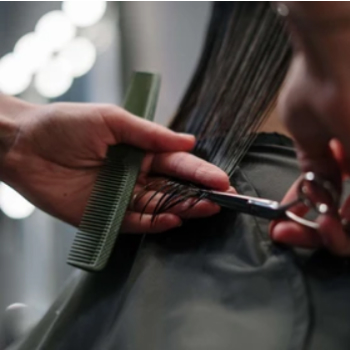

Styling Comb for Hair: Types, Uses and How to Choose

A styling comb is a mid-length comb with two sets of teeth, one fairly wide and one fine, used to part, smooth, shape and finish hair. For most people with straight to wavy hair of average density, one good styling comb covers daily needs. Add a wide-tooth comb for wet or curly hair and a rat-tail comb for clean partings, and you have the kit most stylists work from.
Below, we explain what each comb does, how to match it to your hair, how to use it without causing breakage, and how to keep it clean. We have worked with hair for more than 25 years at our La Jolla studio, so this is how we think about these tools.
TL;DR
- A styling comb typically runs six to eight inches and has a wider-spaced end and a fine-tooth end, so it handles detangling and precise finishing in one tool (Hairfinder).
- Fine or straight hair does best with fine to medium teeth. Thick, wavy or curly hair does best with wide teeth or a pick (GQ).
- Use a comb on wet hair, for partings and for sleek lines. Start at the ends and work up to the roots.
- Choose a heat-safe comb if you style with a blow dryer or flat iron, and wash it regularly.
- For a cut or color that makes any comb easier to use, book with us.
Table of Contents
- What a styling comb does
- Styling comb vs. other combs
- How to choose by hair type
- Materials: what holds up to water, heat and color
- How to use a styling comb step by step
- Perspective: why the comb matters less than the cut
- Keeping your comb clean
- Comb, brush or both?
- Styling for an occasion
- Book a cut your comb will love
- FAQ
- Sources
What a styling comb does
A comb is a row of teeth set into a shaft, and what separates one design from another is mostly tooth spacing and whether there is a handle (Living Proof). The classic styling comb, sometimes called a dressing or all-purpose comb, puts two spacings on one body: moderately spaced teeth at one end and closely spaced teeth at the other.
That split is why stylists reach for it so often. You can work through a section with the wider end, then switch ends to smooth the surface, define a line or set the finish. No tool change, no putting down what you are holding.
Here is what it is good at:
- Parting. The fine end draws a clean line, especially with the tip of a tail.
- Smoothing. Run it over a blow-dried section to lay down the surface.
- Distributing product. Styling cream, mousse or smoothing balm goes through evenly when you comb it in.
- Shaping. Slicking hair back, building a side sweep, or setting a polished finish.
- Light teasing. A little lift at the crown before pinning.
It is not the best tool for everything. A comb is usually the better choice than a brush when hair is wet, when you are working product through, when you want to part or tease, and when you are removing knots (BeautyRoute). A brush does better on dry, long hair where you want loose movement and shine. We cover that side in our guide to the best brushes for every hair type.
Styling comb vs. other combs
The names overlap, so it helps to separate them by job.
| Comb | Teeth | Best for |
|---|---|---|
| Styling (dressing) comb | Wide and fine zones on one body | Everyday styling, smoothing, finishing |
| Rat-tail / tail comb | Fine teeth plus a thin pointed handle | Partings, sectioning, color and foil work |
| Wide-tooth comb | Teeth roughly 1/4 to 1/2 inch apart | Wet hair, thick or curly hair, detangling |
| Teasing comb | Alternating short and long teeth | Volume at the crown, updos |
| Cutting comb | Close-set and wide-set teeth | Cutting over the comb, short tapers |
| Pick / Afro comb | Long, widely spaced teeth | Lifting and shaping curls and coils |
The tail comb has a long thin handle for separating and sectioning, and the wide-tooth comb is generally larger, with teeth as much as 1/4 to 1/2 inch apart (Hairfinder). Professional guides sort combs into many more categories, including barber, beard, roller-setting and straightening combs, but for home styling the six above cover nearly everything.
In our experience, people usually buy too many of the wrong comb rather than too few of the right ones. Two or three that match your hair will outperform a drawer of novelty tools.
How to choose by hair type
Tooth spacing is the decision that matters most. The closer the teeth, the more precision you get. The wider the teeth, the more gently the comb moves through density and curl.
Fine or straight hair
Go for medium or fine teeth for precision and control (GQ). Fine hair shows every line, so a fine-tooth end gives you crisp partings and a sleek surface. If your hair is fine, comb gently. Fine strands can look flat if you smooth them too hard, so use the wider end first and finish with the fine end.
Wavy hair
A medium-to-wide tooth comb preserves wave pattern. Comb through with the wider end, ideally when hair is damp with product in, then leave it alone to dry. Going back in with a fine-tooth comb on dry waves tends to break up the pattern and add frizz.
Curly and coily hair
Wide teeth are the standard for curly hair, and picks or rake combs suit natural textures because they lift at the roots and protect the coils (GQ). Fine teeth can be the wrong choice on dry, tightly coiled hair, where they snag. Detangle wet, with conditioner in. Our guide to how to detangle hair easily walks through it step by step.
Thick hair
Use a wide-tooth comb first to take out knots in sections, then switch to the finer end of a styling comb for the finish. Thick hair holds a lot of product, so comb it in section by section rather than all at once.
Not sure what your texture is?
Hair texture, density and curl pattern all change which comb works. Our pieces on types of hair texture and hair texture explained help you name what you have. If you work in makeup and want formal training in the craft, a hairstyling course for makeup artists is one route to building these skills.
Short, medium and long hair
Length changes the job as much as texture does. With short hair, such as a crop, a taper or a pixie, precision is the goal, and a comb’s teeth leave sharp, crisp lines that a brush cannot (The Art of Manliness). That is why a flat-top or a classic side part is almost always finished with a comb. For long hair, a comb handles wet detangling and partings, while a brush smooths dry lengths.
If you are deciding on a new length before you buy tools, our guides to short hair styles for women and creative men’s haircuts show what each style asks of your daily routine.
Materials: what holds up to water, heat and color
Material affects how a comb feels, how it handles static and whether it survives a blow dryer.
- Cellulose acetate is valued for durability and sustainability, and wood is gentle on the scalp and helps with frizz (GQ).
- Carbon fiber resists static and heat, which makes it a common choice for use with heated tools.
- Metal tail handles are handy for precise partings, but keep a metal comb away from your scalp when you are working with a hot tool.
- Basic plastic is fine for wet detangling and for the shower, but check that it is smooth and flexible.
Quality shows in the teeth: they should be straight and smooth, with rounded tips that will not scratch the scalp, and the comb should be sturdy but flexible so it does not snap (The Art of Manliness). Run a fingertip along the teeth. Any rough seam from molding will catch hair.
If you blow-dry and use a flat iron often, pick a comb that states it is heat resistant. If your hair is color-treated, anti-static and flexible teeth are worth having, since processed hair is more fragile.
How to use a styling comb step by step
Part hair cleanly
For a center part, find the middle of your forehead and draw the tail or fine end straight back to the nape. For a side part, start above the outer edge of your eyebrow and sweep back. Run the thin handle along the scalp to separate sections precisely (Odele Beauty via ShunSalon). Clip the sections you are not working on.
Detangle without breakage
- Start with damp or wet hair and a wide-tooth comb or the wide end of your styling comb.
- Work from the ends upward in small strokes. Detangling from the top can cause damage, particularly on wet hair, which is more fragile (The Independent).
- Hold the hair above the knot with your other hand so the scalp takes no tension.
- Once the lengths are free, comb from root to tip in one pass.
The American Academy of Dermatology is cited as recommending a wide-tooth comb over a standard brush for everyday styling, because the spacing lets it glide without snagging on knots (L’Oréal Paris).
Smooth
After blow-drying, take a section, hold it taut and run the comb along it from root to end. Smooth the surface without flattening the lift at the roots. A little smoothing balm on the comb helps with flyaways.
Tease for volume
One approach is to take a half-inch section at the crown on dry hair, pull it straight up and hold it taut, then gently comb from mid-shaft toward the scalp about three times (ShunSalon). Smooth the top layer over it with the fine end. Brush out teased hair gently at night, starting from the ends, and do not tease over the same spot every day.
Shape and finish
For slicked styles, comb product through damp hair first, shape it, then dry in place. For men’s styles with a side part, comb the part in while the hair is damp and set it with a blow dryer on low heat. Our hair consultation for men page explains how we plan a cut around your daily routine.
Perspective: why the comb matters less than the cut
We have spent more than 25 years watching people fight their hair with the wrong tools. The comb matters, but the cut matters more. A precise haircut, built for your texture and growth patterns, falls into place with a simple styling comb and a few minutes. A cut that fights your hair needs a drawer full of tools to compensate.
That is why our consultations begin with your hair, not with a menu. We look at density, texture, how your hair behaves when it is wet and when it is dry, and what you do each morning. Then we plan a cut and, if you want it, color that suits all of it. Our team is handpicked for technical skill and creative judgment, and we pay close attention to hair health and to safety in the studio.
When you leave, we tell you which comb to use, where to start, and how to finish the style yourself. You should be able to repeat the look at home. That is what a good salon visit is for.
Juiced
Keeping your comb clean
A comb collects product, oil, skin cells and environmental residue, and a dirty one transfers that back to your hair and scalp. A trichologist quoted in The Independent recommends washing hairbrushes every two to four weeks with baking soda and water or diluted shampoo (The Independent). Combs are easier than brushes, because there is nothing to hide in.
A simple home routine:
- Pull out trapped hair with a tissue or the tail of another comb.
- Soak in warm water with a little mild shampoo for 10 to 15 minutes, a method suggested in Vega’s guide to professional combs.
- Scrub between the teeth with a soft brush, rinse well and air-dry on a clean cloth.
- Store the comb in a pouch or drawer, not loose in a bag.
- Keep heat-safe carbon combs away from prolonged heat, and keep a separate comb for chemical treatments.
Wood combs should not sit in water. Wipe them and let them dry flat.
What a licensed salon does
Salons follow stricter rules. In California, before use on a client, non-electrical tools that can be disinfected must have visible debris removed, be cleaned with soap or detergent and water, be dried with a clean paper towel, and then be totally immersed in an EPA-registered disinfectant with demonstrated bactericidal, fungicidal and virucidal activity (California Board of Barbering and Cosmetology). Public health guidance elsewhere says the same order: clean with soap and water and dry first, then disinfect for the contact time the product requires (Toronto Public Health).
That is the standard to expect wherever you book. If you share a comb with family at home, wash it between users.

Comb, brush or both?
A simple rule: use a comb on wet hair, on curly or textured hair, and for precise styling such as sectioning or slicking back. Use a brush on dry hair, on long or fine hair, and to distribute products for loose styling (Living Proof).
A realistic everyday kit looks like this:
- One styling comb with wide and fine zones for daily use.
- One wide-tooth comb for the shower and for wet detangling.
- One rat-tail comb for partings, if you do updos or braids.
- One brush chosen for your length and texture.
For an overview of how everything fits into a routine, see our hair styling checklist and custom styling tips for every hair type.
Styling for an occasion
Partings and sections matter most for events. A tail comb gives the clean lines a polished updo is built on, and a teasing comb gives the base that holds pins. If you want the finished look without wrestling it yourself, our stylists create updos for weddings, parties and other events. See our styling page for details, and take a look at chic hairstyles with accessories for ideas that pair a comb-built base with pins or clips.
Book a cut your comb will love
The right comb helps, but the right haircut is what makes styling easy. At Joel C Ma Hair Studio in La Jolla, we start with a personalized consultation, then tailor the cut, color or finish to your hair and routine. These are our published prices:
| Service | Price |
|---|---|
| Women’s Haircut | $60-$75 |
| Men’s Haircut | $45-$50 |
| Blow Dry Style | $45-$75 |
| Special Occasion (Updo) | from $100 |
| Full Balayage/Hair Painting | $200-$225 |
| Smoothing Treatment | $230-$275 |

See every service, from men’s color to extensions, on our full services page, or visit our homepage to book. If you are weighing a color change, our guides to balayage vs. highlights and haircut ideas for round faces are good places to start.
FAQ
What is a styling comb used for?
A styling comb parts, smooths, shapes and finishes hair. Its two tooth zones let you detangle with the wider end and do precise work with the fine end, so one tool covers most daily styling.
Is a styling comb good for curly hair?
For curly and coily hair, a wide-tooth comb or pick is usually the better primary tool, used on wet hair with conditioner (GQ). A styling comb with a wider zone can still help with partings and shaping once the hair is detangled.
Should I use a comb or a brush on wet hair?
A comb. Wet hair is more fragile, and a wide-tooth comb moves through it without snagging. Start at the ends and work up. Save the brush for dry hair.
How often should I clean my comb?
A good habit is a wash every couple of weeks, and wipe off visible product after each use. A trichologist quoted by The Independent suggests every two to four weeks for hairbrushes, and combs are quicker to clean. Wash it sooner if you use heavy styling products.
Can I use a plastic comb with a blow dryer or flat iron?
Only if it is labeled heat resistant. Carbon fiber and stainless steel are the materials generally made for direct heat, so use one of those near hot tools and keep plastic combs for wet hair.
Sources
- Hairfinder: choosing a styling comb, tail comb and wide-tooth comb
- GQ: best combs
- Living Proof: hair brush types explained
- BeautyRoute: all about hair combs
- The Art of Manliness: a man’s guide to brushes and combs
- ShunSalon: parting and teasing guide
- The Independent: how often to replace your hairbrush
- L’Oréal Paris: wide-tooth comb vs. brush
- Vega: maintaining professional combs
- California Board of Barbering and Cosmetology: health and safety regulations
- Toronto Public Health: hairdressing and barbering infection prevention